Blog

Introducing the RFC (an alternative to the RFP)

Wednesday, February 15th, 2012

RFP vs. RFC

The Request for Proposal or RFP has been described by digital media veterans as the “bane of their existence.” That’s because the RFP process is fundamentally broken in the dynamic context of digital media.

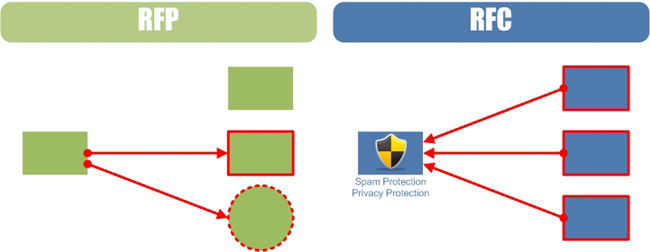
Introducing a new alternative to the RFP: the “Request for Consideration” or “RFC.”

While others have failed to solve the RFP problem by automating it, the RFC takes an entirely new approach by literally turning the RFP inside out. As one media director observed, “it’s like LendingTree for media planners.” Others have called the RFC “a game changer” that could “eliminate the need for the RFP.”

You can learn more about the RFC, how it differs from the RFP, and how it works by attending a free 25-minute webinar on Tuesday, February 21st.

>>> Sessions customized for digital media planners:

>>> Sessions customized for digital ad salespeople:

If you can’t make one of these sessions, but want to learn about the RFC, please let us know and we’ll arrange a webinar for you.

Life of a Media Buyer

Wednesday, February 15th, 2012

Life of a Media Buyer

I love this “what they think” collage on media buyers recently posted on Digiday. So true!  Especially, the “what I actually do” part – slaving away in Excel.

Data Card Trends for 2012

Monday, January 23rd, 2012

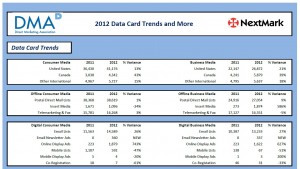
A recent Multichannel Merchant article presents an outlook for digital data to take center stage. While Washington continues to go back to the drawing board to draft new privacy legislation, experienced direct marketers continue to apply online and offline data for responsible direct marketing. For traditional list and data marketing professionals, this creates a need for a new kind of ‘rate card’ or data card for online display advertising. The opportunity to serve this market is open to everyone, and traditional direct marketing services providers have the experience backed with analytical expertise to make a difference.

Data cards are not only available on NextMark, but also on most list management web sites (many of which are hosted via the MarketMax Pro solution). An examples of these are the Parcel Magazine Mailing List and Developerfusion from World Innovators, and Pet Industry TotalBase from List Solutions.

“This online media is no longer new, and should be viewed as an extension of the services that traditional list brokers and managers represent and recommend to their clients,” says Lee Kroll, President, Kroll Direct Marketing.

You can download a free copy of the “2012 Data Card Trends Report” to see how the landscape is changing on our platforms.

Data Card Trends Report 2012

RFP event in Times Square draws a crowd

Wednesday, January 18th, 2012

It was standing room only last night as 180+ digital media pros packed the Manhattan room of the Marriott Marquis overlooking Times Square. Only expecting 140-150, they had to bring in extra chairs to handle the overflow.

Who would have guessed that the mundane topic of RFPs would draw such a crowd on a Tuesday night in January?  The RFP is certainly a hot topic (or sore subject?) among those in the digital media business. (more…)

Why the RFP fails in digital media buying

Wednesday, January 18th, 2012

As a follow up to the 9 ways the RFP fails in digital media buying, this article shows how today’s digital media landscape has rendered the RFP obsolete. (more…)

9 ways the RFP fails in digital media buying

Tuesday, January 17th, 2012

The RFP is broken” is often heard among digital media planning/buying and digital ad sales teams (called “buyer” and “seller” in this article). However, the RFP – or Request for Proposal – has remained an ingrained part of the digital media buying process for guaranteed inventory.

This article explores the problems with using the RFP process in digital media buying. (more…)

2,500+ Top Website Ad Programs Now Available In NextMark

Wednesday, December 21st, 2011

The 1,000 site milestone seemed like a big deal when we hit it last month. But now it seems so yesterday… today we hit another milestone: more than 2,500 sites are now represented in our data card index. Congratulations to the Accounts and Market Intelligences teams for establishing the relationships and doing the research and data entry to hit this goal ahead of schedule.

We’re running at a pace of more than 200 sites per day so it won’t be long before we hit our next milestone: 10,000 sites.

Yikes – it costs an agency $40,356 to create and execute a digital media plan

Wednesday, November 23rd, 2011

There’s been a lot of talk about how inefficient the process of placing digital advertisements is as compared to TV and other traditional media.

For example, according to Google, “Managing display ad campaigns can take up 28% of the budget in overhead, compared to 2% for TV. Which means for every $100 you spend on display, $28 goes to process management such as negotiation with multiple sites, re-planning, faxing insertion orders, trafficking hundreds of ad tags and so on. Such inefficiencies have impeded the growth of the industry.”

Being process and workflow geeks, we wanted to understand this inefficiency at a  deeper level.  So, we conducted our own study to drill into this from a media agency’s perspective.

The goal of the study was to answer a basic question: “How much does it cost an agency to create and execute a digital media plan?

We faced our first big challenge right out of the gate. This question is not as simple as it seems because the cost depends on myriad factors.  When we asked “how much?” the answer we kept getting was essentially, “it depends on so many things I could not tell you.”  Dave Smith of Mediasmith was kind enough to enumerate the 17 factors that influence the cost of a media plan. So, to move forward we constrained the inquiry to a specific scenario of a $500,000 media budget buying guaranteed online display inventory on 10 websites with 10 placements each.

The second big challenge we faced was in calculating and presenting the the findings. Just knowing the bottom line cost does not provide much insight. Knowing what drives the cost is where the insights begin. So, we developed a Digital Media Planning Workflow Calculator which is an activity-based costing model.  We refined this model throughout the process and plugged in the data we gathered from digital media planning experts through our interviews.

Finally, we crunched the numbers.

The answer? It costs $40,356 to create and execute a media plan under the $500k scenario.  This works out to about 8% of media spend.

8% of media spend is much lower than Google’s number of 28%. However, I believe their study covered additional activities such as advertiser, creative, and publisher activities while ours was limited to media activities within the agency.  The 8% seems to be “in the ballpark, but a little low” as we validated the findings.  A rule of thumb is 10-12% of media spend varying by media spend.

Where does all that money go? We dissected the process by task and by job function and identified the hot spots.  It’s important to know which job functions are performing the tasks because the costs of job functions vary widely (e.g. Media Director versus Ad Trafficker). The reporting phase is the most time-intensive at 113 hours but the strategy phase is the most cost-intensive at $11,454.55 because of the personnel involved.

There is a tremendous amount of manual labor involved in the process of creating and executing a media plan. We counted 482.5 hours per campaign involving 11 different job functions at an agency. That’s a lot of work and people involved!

To get the detailed analysis supporting the result (or to run your own numbers), download the Digital Media Planning Workflow calculator – it’s free and easy to manipulate in Excel.

1,000+ Top Website Ad Programs Now Available In NextMark

Monday, November 14th, 2011

Last month, we announced a milestone: 50 Top Web Publishers Tap NextMark’s New Ad Sales Tool. Today, we report two more milestones:

1) That “50” number is already old news; more than 100 publishers are now on board. In the past month alone, another 50+ web publishers have signed on, bringing the count to 107.

2) More than 1,000 website advertising programs from these web publishers are now represented as “data cards” in our advertising program database. In fact, as of today 1,414 data cards have been published:

At the current rate, more than 2,500 of the top website advertising programs will be indexed and available by the end of the year.

Unlike in other media channels, digital media planners have never had a “go to” source of comprehensive information about digital advertising programs. They’ve used myriad tools and countless hours of drudgery to cobble together the information they need to present a professional media plan to their client, the advertiser.

Sure, media planners have long had good tools like comScore and Nielsen to get site metrics such as visitors, page views, and audience profiles. However, site metrics only provide a fraction of the information needed to produce a solid media plan.  Furthermore, site metrics tools are typically disconnected from the media planning system.

As a result, media planners waste a great deal of time tracking down the information they need for their media plan. Did you know that it takes more than 480 hours and costs an agency more than $40,000 to create and execute a media plan? Ouch.

With access to a data card database, a digital media planner gains access to all the information they need to make decisions and to create their media plan. Their life just got a lot better: no more late nights tracking down publisher details and pasting into other systems like Excel and Powerpoint. It’s all available at their fingertips in their media planning system. Now, they can spend more time on publisher relations, strategy, and other high-value activities.

Ad sales representatives from web publishers also gain an advantage by publishing data cards.  By making it easy for the media planner to buy from them, they get an increase in sales leads… and those leads are better qualified. So, they waste less time servicing cold leads and more time closing deals.

A prerequisite to a viable data card database is creating data cards for each and every advertising program. Nobody has ever done this before for digital ad programs. This is a monumental task requiring thousands of phone calls, tons of research, and many person-years of data entry. Basically, it means scaling up the research from a few sites on a single media plan to the tens of thousands of sites that sell guaranteed inventory on all media plans. And, because the market is in constant flux, this sisyphean work never ends.

NextMark is up for this challenge. We’ve done this before. We’ve published and maintain more than 110,000 data cards for other media channels. We are now taking a page out of our playbook and adapting our technology and methods to digital media channels: online display, mobile display, and online video.

We’re just getting started, but this early progress is a good indication of the value that data cards bring to both media planners and publishers.
50 Top Web Publishers Tap NextMark’s New Ad Sales Tool

Thursday, October 13th, 2011

NextMark’s new ad sales tool is gaining widespread adoption among leading website publishers: in just two months since its launch, more than 50 publishers representing more than 900 of the hottest websites have signed on to publish data cards with NextMark:

Data cards are basically a “media kit on steroids.”  It’s a fresh concept for digital media adapted from a proven method in offline media. It’s a better way to connect with media planners: data cards make it easy for them to discover your media programs and to include them in their media plans.

Don’t miss your chance to gain a first mover advantage… learn more on the data card publisher page.