1) That “50” number is already old news; more than 100 publishers are now on board. In the past month alone, another 50+ web publishers have signed on, bringing the count to 107.
2) More than 1,000 website advertising programs from these web publishers are now represented as “data cards” in our advertising program database. In fact, as of today 1,414 data cards have been published:
At the current rate, more than 2,500 of the top website advertising programs will be indexed and available by the end of the year.
Unlike in other media channels, digital media planners have never had a “go to” source of comprehensive information about digital advertising programs. They’ve used myriad tools and countless hours of drudgery to cobble together the information they need to present a professional media plan to their client, the advertiser.
Sure, media planners have long had good tools like comScore and Nielsen to get site metrics such as visitors, page views, and audience profiles. However, site metrics only provide a fraction of the information needed to produce a solid media plan. Furthermore, site metrics tools are typically disconnected from the media planning system.
With access to a data card database, a digital media planner gains access to all the information they need to make decisions and to create their media plan. Their life just got a lot better: no more late nights tracking down publisher details and pasting into other systems like Excel and Powerpoint. It’s all available at their fingertips in their media planning system. Now, they can spend more time on publisher relations, strategy, and other high-value activities.
Ad sales representatives from web publishers also gain an advantage by publishing data cards. By making it easy for the media planner to buy from them, they get an increase in sales leads… and those leads are better qualified. So, they waste less time servicing cold leads and more time closing deals.
A prerequisite to a viable data card database is creating data cards for each and every advertising program. Nobody has ever done this before for digital ad programs. This is a monumental task requiring thousands of phone calls, tons of research, and many person-years of data entry. Basically, it means scaling up the research from a few sites on a single media plan to the tens of thousands of sites that sell guaranteed inventory on all media plans. And, because the market is in constant flux, this sisyphean work never ends.
NextMark is up for this challenge. We’ve done this before. We’ve published and maintain more than 110,000 data cards for other media channels. We are now taking a page out of our playbook and adapting our technology and methods to digital media channels: online display, mobile display, and online video.
We’re just getting started, but this early progress is a good indication of the value that data cards bring to both media planners and publishers.
“Long live the Excel spreadsheet as the tool of choice. We speak anecdotally among industry circles and in class about our seemingly lifelong relationship with manual approaches and tools – and with Excel. We have a love-hate relationship with Excel. It turns out that the stats bear this out. But, we are still more manual and Excel-jockeying than we should be, if we want to scale our efforts.”
“When asked which tools they used to manage both programs together, US marketers most commonly said spreadsheets (59%)—seemingly favoring a simple, and most likely inadequate campaign management solution over more advanced tools…. That’s not to say that marketers aren’t also relying on some form of analytics or management tool in combination: 48% used a marketing analytics tool, 40% used web analytics tools and about a third of marketers relied on either a third-party ad server, business intelligence platform or their own proprietary internal tool.”
Our own research confirms the widespread use of Excel as the “glue” that holds together the process of creating and executing a media plan. There are many tools used throughout the process that provide sources of data, but the media team turns to Excel bring it all together.
Excel is excellent at providing a flexible and easy to use tool for gathering, organizing, and presenting data. However, it has at least two major drawbacks:
Excel has no media-specific features. It doesn’t know what a campaign, placement, impression, or click from any other cell on a spreadsheet. As such, you have to work harder to set up and populate the spreadsheet.
Excel is terrible at storing and re-mixing data. Sure, you can save your campaign results spreadsheet on your shared drive. But if you want to know the results for a client over the past two years and that is stored in 50 different spreadsheets, you’ve got a problem.
With our next generation digital media planning tool, we’ve taken on the challenge of building “Excel on steroids.” We want to take the best parts of Excel and extend that with media-specific capabilities that only a database-backed system can provide.
When it comes to creating quality media and list recommendations, it helps to have some context for your proposal. Every good media and list recommendation includes the following attributes: format, content, and insight.
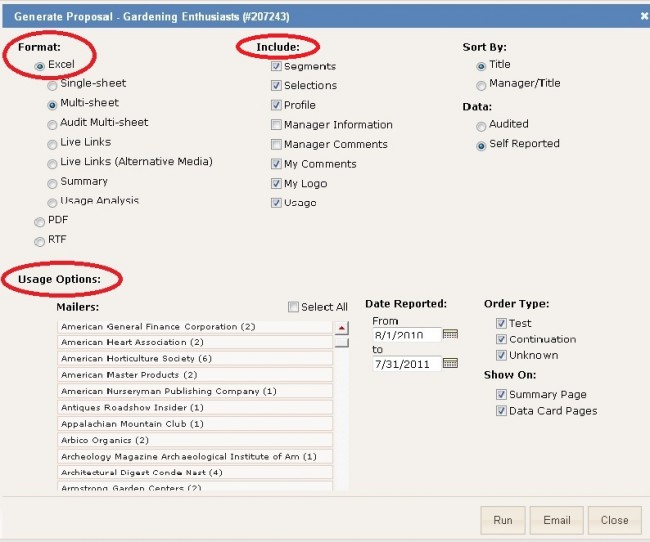
It can be helpful to take a step back and think about how your campaign management tools can help you in the process. For example, the ‘Generate Proposal’ feature in NextMark’s media planning tool can be used as a guide in the preparation of client recommendations. Take a look at the snapshot below for an audience of prospective gardening enthusiasts:
The format (Excel, PDF, or RTF) allows the creator of the recommendation to determine the level of interaction the end user may have. For example, while a PDF (Portable Document Format) may be appealing, it does not allow for easy editing and customization of the final output. However, a spreadsheet (Excel) workbook can be customized, edited, enhanced, and even integrated with other Microsoft Office programs like PowerPoint. It provides a lot of flexibility, not only for viewing but also for analysis.
And of course, there is also the RTF (Rich Text Format) which is easily read by Microsoft Word. While this may be a common format among traditional direct marketers, it provides fewer benefits due to the limitations of word processing applications. The content of data cards varies due to the depth and breadth of each media program or mailing list. This creates issues related to pagination and alignment that can be more easily resolved with alternative output formats.
The content options enable the creator to generate media and list recommendations that are relevant, while excluding information that may be considered proprietary from a media brokerage perspective. For example, a recommendation made by a list broker for a catalog marketing client may include additional segements, selects, and profile information for discussion purposes related to refinement and targeting. However, the manager information may be suppressed intentionally to keep focused on the value that the media broker brings to the campaign management process.
Additional insight may be applied as well. With access to the mailer usage database, media brokers can also leverage the experiences of others and help speed up the decision-making process. It’s a great way to uncover new media to test based on what has worked for others. It is often the not-so-obvious recommendations that outperform the market average for response and lifetime value (LTV).
Keep these three things in mind as a guide for media and list recommendations, but don’t feel like you need to change your personal style. What’s most important is what sets you apart as a trusted advisor for your clients.
Leo Scullin of Arkose Consulting highlights the “pain points” of the digital advertising process in the presentation above. The sea of red ink is the friction that wastes agencies’ time and creativity, clients’ investments, and publishers’ revenue.
One of the best sessions at this week’s iab Annual Leadership Meeting, was “The Great Debate” that pitted agency versus publisher on the topic of buying through exchanges. The subtitle of this session was “Resolved: A Data-Driven Ecosystem Permanently Disadvantages Publishers.”
This was the last session of the conference. Anyone who left early missed out!
Participants in the debate were:
John Battelle, Founder and Executive Charmain, Federated Media (moderator)
Michael Barrett, CEO, Admeld
Quentin George, Chief Digital Officer, Mediabrands
Michael Zimbalist, Vice President of Research and Development Operations, New York Times
Ramsey McGrory, Vice President Marketplaces NA, and Head of Right Media Exchange, Yahoo!
@0:44 Quentin George describes a Demand Side Platform (DSP): “For us, DSP fulfills 3 core functions. First, it aggregates and provisions inventory for us across multiple sources and it puts in a dynamic marketplace so we can buy against that. Second, it allows us to ingest multiple sources of data so we can describe attributes that we want to buy against. And then it has some kind of decisioning algorithm that allows us to optimize against a particular outcome.”
@2:08 Quentin George stages the problem: “Our Intent at the highest level is to figure out ways how we can spend more money in digital. It’s of great concern to our clients, our brands. It’s of great concern to our creative partners that are desperately trying to capture and engage consumers.”
@2:30 Quentin George describes the challenges in buying digital media: “It keeps us up at night because we’re ultimately responsible for making the financial investment decisions and it’s just too difficult. It costs us 2.7 times the labor to spend a dollar in digital than to spend a dollar in television. And, you know, we don’t benefit from that. Agencies don’t get paid for inefficiency. We get paid on results. And so we’re just trying to use data and use technology in a smart way to create a fair marketplace where we can get to fair valuation, whatever that means. And the challenge for us is we’re in this averaged marketplace where all inventory is averaged. Everything is dollar denominated down to a CPM. In our heart of hearts, on both sides we know it ought not to be so. But the problem is to get to what is valuable, what ought to be premium, and what is not… I don’t think we get there just with people. We need sophisticated technology and data to get there.”
@3:37 Ramsey McGrory describes the shift in power to the demand side: “What’s changed in the last couple of years is the buy side has woken up. They’re using data, technology, people, and process to be smarter. So, what’s changing is the leverage in the conversation. Oftentimes a publisher has fantastic audience. Oftentimes the agency may actually know more based on data they have and based on third party data. But I think the marketplace is changing. And what publishers have to do is get used to that fact and change the way they sell to embrace what’s happening.”
@4:16 Michael Zimbalist expresses publishers’ reluctance to feed the ecosystem: “We can and do bring data that is from our audience. Whether or not it’s explicit data that they’ve shared with us, we want to be careful that that data remains with us. That’s another point of anxiety around this ecosystem. We don’t want to essentially sell the lifetime value of one of our customers for a flight of advertising.”
@5:00 John Battelle raises the economics of selling data: “You load 60 tracking pixels when you go to Wall Street Journal dot com. So if all those are gone, I’m not sure that Rupert is so into investing in wsj.com because he’s making money because those tracking pixels are there.”
@5:17 Michael Zimbalist concludes what happens if the data-driven ecosystem goes away: “We go back to context as proxy for audience.”
@5:57 John Battelle challenges everyone to explain the value of advertising and the unwritten contract with consumers: “We have this massive gulf between what the consumer is getting and what the consumer doesn’t understand what the deal is that they’re getting. I think from a cultural standpoint, it’s all of our jobs to explain the value of why we’re doing this because there’s a lot of fear because fear stems from ignorance. So, we have to address that question because there’s so much good stuff that comes from this. Then it’s up to us not to do evil things with it.”
Unfortunately, some of the best parts were left out of the digested video (the iab must want you to go to the conference ;-). Here are other highlights from my notes which may be paraphrased:
John Battelle quotes an anonymous source that would not participate in exchanges: “I will never give them any of my inventory. This is a life and death battle.”
Michael Zimbalist: “The best possible scenario is we completely control the audience. We want as few people as possible between us and our audience.”
Quentin George: “Our reliance on third party data is a lot less. We are using more first party data.”
Quentin George: “The algorithm is not going to respond favorably to high price floors.”
Michael Barrett: “The challenge is to turn $1 CPM inventory into $5 CPM inventory without turning $30 CPM inventory into $5 CPM inventory.”
Michael Barrett: “70% of ad spend is in up front direct sales.”
John Battelle quotes an anonymous source that had an unfavorable view of exchanges: “They are going to screw everyone. They should be a regulated oligarchy.”
Upon discussion of the automation that DSPs and exchanges bring, John Battelle asks: “Should a 24-year-old media planner be looking for a new job?”
John Battelle: “Passion, voice, and point of view is what draws an audience and community.”
Randall Rothenberg: “This is really a debate between modernism and post-modernism.”
Ramsey McGrory: “a site may not be the best proxy for an audience.”
Quentin George cites a growing problem in the ecosystem: “Many agencies arbitrage publishers’ inventory and this is wrong because it creates a conflict with their client.”
Quentin George: “activity is often a bad proxy for results.”
The session illustrated the growing tension between agencies and publishers. They are not converging on a solution that both sides can agree on. In fact, it seems they are diverging from an agreeeable solution. Agencies want to buy using real-time bidding on transparent inventory enhanced with data through exchanges but publishers want to sell inventory directly up-front and guaranteed without a series of intermediaries.
Who will set the market rules?
In conversation afterwards, Tim Suther of Acxiom reminded me, “Remember the Golden Rule: he who has the gold makes the rule.” But who has the gold here? Is is the agency who represents the money? Or the publisher who represents the desirable audience?
In my opinion, both sides have the gold. Like any good agreement, we need a solution that has both parties coming away from the transaction feeling like they got a good deal.
There’s big demand for postal mailing lists lately. Despite its traditional nature, postal is still one of the most powerful channels for driving both offline and online traffic (and sales!).
The key to driving quality traffic through postal is using a quality mailing list. In fact, experts agree that your choice of mailing lists is the single most important factor in driving your results.
There are more than 60,000 mailing lists available. Without the right tool, it’s unlikely you’ll find your ideal lists. Fortunately, NextMark provides a Mailing List Finder tool. It’s easy to use. And, best of all, it’s free.
Here’s a short video. It’s out of date (we’ve since redesigned the site), but it gives you a good idea of the service.
More evidence of the accelerating pace of advertising moving online. According to a MediaPost story, Deutsche Bank predicts double digit growth in online advertising “for the foreseeable future.” This is great news for anyone who is buying or selling online display, mobile, and search.
Adam Cahill’s ClickZ article Quality Is Job One shows how a good brand can end up in a bad neighborhood by using demand-side platforms (DSPs) to serve ads to audience regardless of site context. (more…)
"Despite often having an edge over the bigger publishers when it comes to targeted content and unique audience attraction, niche sites still tend to work harder to get your advertising business…mainly because they are off the radar of a lot of media and measurement tools. From them, the planners and buyers get better service and response times, better rates, more campaign flexibility, and shared research. From their site's niche focus, the advertiser gets lifts in unique visitors, better or more control over content opportunities and cross media platform offers, and hopefully better campaign achievement (or equal at perhaps less cost or in less time)."
Hollis proves the value of niche advertising. How to find those niches?
Many agencies have been too slow to recognize just how much of their actual value to marketers has shifted from “the big creative idea” and “the most efficient media buy” to “the most sophisticated and innovative media planning.” In the always-on world, the interdependencies between the media and the message have never been more important. the planner (not the creative of the buyer) has in fact become the driving force in today’s marketing. It is the planner who chooses among media distribution platforms, who ensures that creative executions are integrated across the right touchpoints, and who leverages insights into consumer behavior to support advertising with more relevance and impact. (more…)