Blog

Digital media planning just got even easier

Wednesday, December 19th, 2012

Planner campaign start

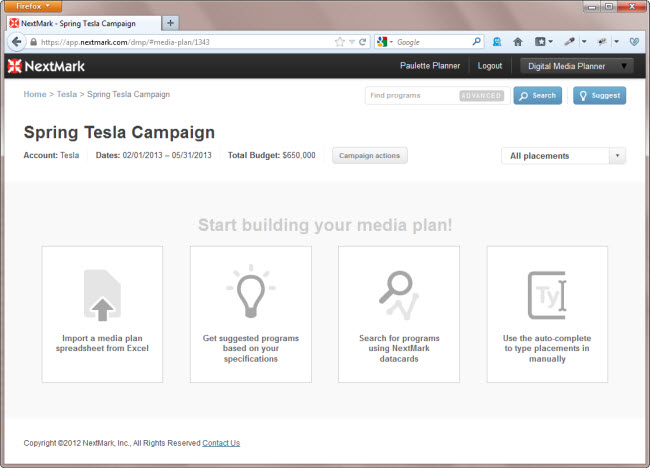
Less than three weeks ago, we introduced the new Digital Media Planner tool. It was built specifically to make digital media media planning easy. Today, we upgraded the software to make it even easier. Now when you create a new campaign, you are greeted with four easy options to get started: import a file, suggestion tool, search tool, or type-ahead. In every case, the system is making your life as a media planner easier.

Want to learn more about the tool? Go to http://www.NextMark.com/planner.

NextMark Aims to Replace Excel With New Digital Media Planner

Sunday, December 2nd, 2012

Scottsdale, AZ – December 2, 2012 – NextMark, Inc. today unveiled a new system for automating digital media planning workflow at advertising agencies at the iMedia Agency Summit conference in Scottsdale, Arizona. The new system is called Digital Media Planner.

According to NextMark’s research, it costs agencies more than $40,000 per campaign in labor costs to create and execute a digital media plan and executing a digital media plan involves a tedious 42-step process. One of the main reasons for the high cost is the use of Microsoft Excel and manual processes. It’s a process that’s ripe for automation. The promises of workflow automation are to save time, eliminate mistakes, reduce transaction costs, increase agency profitability, and increase employee morale.

However, purpose-built workflow automation systems have so far failed to gain widespread adoption among advertising agencies. A survey of 65 digital media executives at the conference revealed that 80% (52 of the 65) still use Microsoft Excel and manual processes to create media plans while only 20% use a workflow system.  The four main reasons for failed adoption of workflow system alternatives to Excel cited are: too cumbersome, too limited in functionality, too expensive, and not integrated.

NextMark is aiming to replace Excel in the digital media planning process with its new Digital Media Planner system. The Planner is designed for independent digital advertising agencies, but can be used by agencies of all types and sizes. The system is accessed through the web as cloud-based software running on an enterprise-class SAS-70, Sarbanes-Oxley compliant platform.

Joe Pych, CEO of NextMark, unveiled the Digital Media Planner system and demonstrated the its main features at the conference including: importing from comScore Key Measures output; accessing advertising program details such as placements, inventory, rates, and audience profile via its data cards; creating a media plan using an intuitive spreadsheet interface; and exporting to Google’s DFA Ad Server. Mr. Pych indicated the system is available for free.

“Our goal for is to make digital media planning easy,” said Mr. Pych. “It seems like fighting windmills, but it’s about time someone replaced Excel because it causes so many problems and widespread unhappiness among digital media planners.”

Initial reactions to the Planner among conference attendees were positive. “My media planners are going to hug me for bringing this back to them!,” said Melissa Hodgdon, Vice President, Media Director of Engauge.

More information about NextMark’s Digital Media Planner is available on NextMark’s website at http://www.NextMark.com/dmp.

Why is automation important to digital media directors?

Sunday, December 2nd, 2012

Here is the presentation I gave this morning to a packed room of 70 media executives at the iMedia Agency Summit at the Camelback Inn in Scottsdale, AZ (super nice place btw!):

I presented our research that shows it costs more than $40k to create and execute a digital media plan and that executing a digital media plan involves a 42-step process. This process seems so ripe for automation with the high cost and labor. However, the Media Planning Tools Survey show of hands survey overwhelmingly concluded that Excel is still the top choice among media pros (as I’ve previously blogged). No surprise there… thankfully, because the rest of my presentation depended on that!

Despite the volume of screen shot slides in the presentation, I did rapid-fire 8-minute flyover of our newest creation: the Digital Media Planner system. We just launched it two days ago. This is the first time I’ve shown it off in public. I thought the iMedia Agency Summit was the perfect venue for the reveal since it is designed specifically for media planners at independent agencies. We structured our development timeline to launch in time for the conference.As always, our fantastic development team hit their dates (we’re big on shipping on time).

Being the first public reveal of the Digital Media Planner, I was afraid nervous nobody would like it. But based on a show of hands survey, virtually everyone did like it. Yay! So, that gave my ego a big boost (although maybe they were just being nice to me because I bought them all breakfast).

Why is automation important?

The main part of the session was to ask the audience the question: “why is automation important?” in digital media planning. Hands went up and I heard lots of smart answers, including roughly in this order:

  1. “profitability – the faster we can get things done, the more business we can take on”
  2. “efficiency – faster workflow – automation makes it easy to make on-the-fly changes quickly”
  3. “streamlining the process”
  4. “minimizes risk and human error”
  5. “media planner happiness”

I was pleasantly surprised that “profitability” was the first answer within two milliseconds. Most think “efficiency” first and business growth comes after a few minutes.  Lack of automation is clearly holding back both the top and bottom line at digital agencies. I’m glad someone answered “happiness” because that’s what it’s all about IMHO (and because I littered the place with “happiness” mugs). You find happiness is the core value of automation when you repeatedly ask why. And that’s why we internally call the development of the Digital Media Planner system, the “Digital Media Planner Happiness Project.”

Besides the free food, everyone at the breakfast got a free limited-edition coffee mug, hand-crafted by me. I created the smiley face image by hand using one of my favorite apps on my iPad – Paper by FiftyThree. Below is a picture of the mug as the group was filing in. It says “digital media planner happiness project” on the other side just like on the title slide of the presentation. Let me know if you want one of these mugs – I made 200 and there will be some left over.

Now it’s time to get outside and enjoy the warm, sunny day here in Scottsdale. Speaking of happiness, I’m very happy they hold these conferences at such beautiful places!

NextMark unveils a new Digital Media Planner tool

Friday, November 30th, 2012

After two years in the making, I’m very happy to unveil our latest creation: the Digital Media Planner – a system specifically designed to help digital media planners to get their job done more easily.

The 42-step process to create and execute the digital media plan costs agencies an average of $40,000 per campaign in labor costs. This cost does not include creative, technology, or other costs to deliver  the campaign. Just the media department labor cost. It’s a very expensive process.

The digital media planning process is ripe for automation because of the combination of high costs and repetitive, manual labor. However, prior solutions have failed to gain widespread adoption in the marketplace.  Despite the availability of various workflow systems, the digital media planning process is still typically done manually using Excel, email, shared drives, and generic tools. In our research, we discovered the reasons for system adoption failure were a combination of the following factors: (1) too cumbersome (2) too expensive (3) too limited in functionality or (4) not integrated.

With that in mind, we took a fresh approach to solving this problem this problem. (more…)

3 Reasons Why “Programmatic Premium” Doesn’t Work Today

Wednesday, November 7th, 2012

This article was originally published in The Makegood.

There’s been a lot of discussion lately about “programmatic premium” – using machines to fully automate the purchase of premium advertising inventory. It seems like every conference lately has someone from Kellogg’s on a panel saying programmatic premium is GR-R-REAT with very impressive statistics to support their claims.

The Ad Exchanges, DSPs, DMPs, SSPs, and various other TLAs (three letter acronyms) you see on Terry Kawaja’s Display Lumascape have certainly been successful at automating the buying and selling of remnant inventory. But remnant inventory represents only a small slice of advertising spending. According to Mike Leo, CEO of Operative, only 18% of digital media advertising budget is spent through exchanges.

Advertising technology stack vendors are now hungrily eyeing the other 82% of the pie that is currently being spent on premium advertising inventory through guaranteed contracts. Their story is their technology will work just as well for premium inventory as it has proven to be for remnant inventory. However, in practice, they face three very significant challenges.

First and foremost, today’s exchange-based technologies are not well-suited for buying guaranteed inventory. Exchange-based technology was built to optimize bids on an impression by impression basis in real-time. The lifecycle of the process is literally 30 milliseconds and does not involve humans. It’s just a simple transaction between two computers based on pre-programmed bidding algorithms.

In contrast, buying guaranteed inventory today is a messy 42-step process spanning weeks involving humans from multiple organizations, RFPs, dinners, ballgames, proposals, contracts, negotiations, reviews, signatures, and such. The big problem/opportunity with buying guaranteed inventory is not in optimizing bids, but rather in optimizing the workflow. Optimizing workflow within the agency and among trading partners requires a very different set of technologies than an algorithm for optimizing bid prices on a transaction.

To avoid all this messy workflow, some ad tech vendors ignore it and try to force-fit premium inventory into exchanges. They want to move the inventory into the game they are already good at playing.

That leads to the second problem: premium publishers don’t want to put their inventory in exchanges because it drives down the value of their inventory. Publishers joke that RTB really stands for “race to the bottom.” According to Walter Jacobs, EVP of Sales at Turner Digital “We don’t participate in any real time bidding or private exchanges at this point. It’s a very funny thing, because to the untrained eye, we might seem like an unsophisticated old media company that is scared to embrace technology. The opposite couldn’t be much closer to the truth. […] We believe the downside of RTB and private exchanges is that it fragments audiences.”

Ad tech vendors need to respect the needs of the premium publisher. Publishers are certainly keen to streamline their workflow, lower their transaction costs, and to make it easier to buy from them. However, they will never do that in an environment that commoditizes their inventory and creates channel conflict with their ad sales teams.

A third problem that is rarely mentioned, but perhaps trumps them all is the dirty secret that advertising agencies are making a ton of money on the old way of buying guaranteed inventory. Starting around 1990, agencies have moved from media commission models to hourly (or “cost plus”) pricing models. According to the 4A’s Labor Billing Survey Report, 91% of proposals today are priced based on hourly rates (despite scoring lowest among alternatives on the Grossman Grid). In other words, the more time they spend on a job the more they get paid for the job.

A typical digital media plan costs an agency $40,000+ in labor to create and execute. These costs plus a profit margin are the revenue for the agency. As such, agencies are reluctant to adopt technologies solely on the basis of efficiency because it will cut their revenue. As an engineer, it kills me there’s a disincentive to be more efficient. But that’s the cruel reality of the situation. Any new technology has to have value beyond just efficiency to give the agency a really good reason to break rank and to go through the painful process of establishing a new compensation model that preserves their revenue.

There’s a billion dollar opportunity for automation in premium inventory. Ad tech stack vendors have proven that automation works in remnant inventory. Now it’s time to raise the bar and evolve the automation to support the more sophisticated needs of the buyers and sellers in premium advertising inventory.
The 10 Biggest Problems with RFPs

Friday, October 26th, 2012

This article was originally published in The Makegood.

It’s the fall media planning season. It’s the time of the year when leaves fall and make a mess of all the yards in the neighborhood. It’s also the time of the year when RFPs fall and make a mess of all the desks and inboxes in the media world.

In The Fiesta Nobody Loves, Doug Weaver writes:

“As we enter the fall season and another online advertising year begins to ebb, the human-powered agency RFP process continues — against all odds — to cling to life. For those looking in from the outside, the RFP (request for proposal) is a weekly ritual in which an agency sends out digital planning requirements to five times as many sites and networks as they’ll be able to buy from. The sales reps get all lathered up, put their entire organization into Def-Con 4 status, and turn a detailed proposal around in 36 or 48 hours with relatively little quality information and — unbeknownst to them — very low odds of really being considered.

“Just about everyone you talk to wants this thing to go away. Clients see it as a waste of their billable hours; planning teams feel that it burns out their people; publishers see it as a massive resource drain; and holding companies are desperate to automate it out of existence. It’s the Rod Blagojevich of business practices.”

It’s no secret to anyone in the business that the digital RFP is a frustrating mess. But why is the RFP universally disliked? Here’s a list of its top 10 problems: (more…)

Digital Media Proposals That Win

Monday, September 24th, 2012

What are digital media buyers looking for in proposals, and what gets them to say ‘yes’?

After speaking with over 100 interactive media planners and publishers this month, I was surprised to learn how much variability there is in the quality of digital media proposals. It was also a challenge to find the ones that were most effectively aligned with clients’ goals and objectives. I was intent on helping publishers respond more effectively, so I asked a subject matter expert (SME) on the buy side, “what are the top five things you look for in an RFP response?” Here’s what he said:

#1 Completeness — don’t expect to be considered if you neglect to provide a completed proposal with flight dates, impressions, rates and cost for all placements. This may sound obvious, but not all proposals come through with this required information.

#2 Rationale — publishers need to provide rationale for the campaign as a whole, and for all of the proposed pieces of the plan. Publishers need to answer the following question: “Why is the overall campaign and each placement a good fit for the advertiser’s target and goals?”

#3 Differentiation — make sure your points of differentiation are easily identified and clear. If you received an RFP, then it is likely that your competitors have received one too.

#4 Clarification — a vendor who does not ask questions is likely to be perceived as disengaged in the RFP. If you pay close attention and ask good questions, then you’ll be far more likely to address the core needs of the advertiser and subsequently have a much better chance of being accepted.

#5 Brief Sales Pitch — it’s not always true that buyers don’t want to be sold. Here’s what my SME had to say in conclusion of the top 5 things he looks for in an RFP response:

“You gotta sell me. If you aren’t into it, then I won’t be… but just don’t go on too long.” Joel Nierman, Marketing and Media Director at Critical Mass

In addition to these insights from Joel, I’d like to offer an observation of my own. While content is king, format is queen. Media planners have not yet embraced the applications designed to streamline digital media acquisition and ad trafficking processes, but continue on as Excel junkies suffering from spreadsheet substance abuse.

So the takeaway is this — be creative and differentiate from the competition, but NOT at the expense of changing format. Make the numbers portion of your proposal fit the RFP template and it will be easier for the planner to say ‘yes’ to everything else. If this is not provided, then ask the question (#4 above) “how can I best provide you with the numbers so you don’t need to transpose them on your end?”… now you’re helping the buyer on an individual level as well.

John Henry vs. Programmatic Buying

Wednesday, September 19th, 2012

Two articles published this week have caught my attention despite my recently self-imposed “information diet.” They rise above the din because of the keen observations they make on the changing workforce at advertising agencies.

“There’s a lot of inexperienced people on the ground doing a lot of grunt work.” – Forrester analyst Joanna O’Connell in Agencies in the Age of Machines by Brian Morrissey

“Accepting that there will be fewer and fewer staffers at the agency doing the grunt work of RFPs and spreadsheets: Do you really see more than a tiny handful of those people being retrained and redirected into right-brain Marketecture jobs?” – Upstream Group founder and CEO Doug Weaver in Brave New Agency

The disruptive force here is the rise of automated, programmatic buying machines. These machines eliminate manual human toil and efficiently grind towards their narrow objectives.

These articles remind me of the legend of John Henry vs. the steam-powered hammer.  In this folk tale, the status quo of hard manual labor is disrupted by a new technology: the steam-powered hammer. The laborers’ hero, John Henry, challenges the machine to a race. Through super-human strength and determination, John Henry wins the race. However, he dies at the finish line from over-exertion.

Is the digital media workforce composed of modern day John Henry’s? Will we suffer the fate of John Henry and die in our race against the machine? That’s one possible future.

Or can we adapt from laborer to knowledge worker? For this, we have to move from driving spikes to driving strategy. We have to move beyond today’s sledgehammer – Microsoft Excel – to tools that free our time and our brains to focus on higher-value pursuits. We have to train our right brain. Unfortunately, many won’t make the transition and will become obsolete. But those who adapt will survive and thrive.

Visit NextMark at IAB MIXX Oct 1-2 in NYC

Friday, September 14th, 2012

Please come visit the NextMark team at the IAB MIXX conference on October 1-2 in New York City. We’re really excited to be part of this conference – it’s *the* cornerstone digital advertising event of Advertising Week 2012. The IAB has put together a phenomenal agenda: the art and science of digital creativity, the ramifications of viewable impression metrics, Dennis Crowley of Foursquare, Neal Mohan of Google, Microsoft, Sheryl Sandberg of Facebook, AOL, Mastercard, Twitter, Tumblr, elections, Charlie Rose, Marc Andreesen, and more. Wow!

You can visit us and the other vendors for free with “expo only” passes. You’ll find us in the exhibit hall at booth #103. But when you see the agenda, you’ll probably want to go “all in” with the full conference pass.  Check it out here: http://www.iab.net/mixx


Need a replacement for Google’s DoubleClick Ad Planner?

Monday, August 27th, 2012

Google has just announced it will discontinue a number of features of its DoubleClick Ad Planner on September 5, 2012. Among the changes, Google is dropping “domains or ad placements that are not part of the Google Display Network (GDN).”

Some are unhappy with these changes because they’ll no longer be able to use the tool for direct sold premium placements. These placements are outside the GDN and still comprise the majority of online display media spending today.

That’s the bad news. The good news is there are alternatives to help you through the transition.

For non-GDN site and placement information, you can use the IAB Digital Advertising Directory. It’s a free tool with virtually all the top sites indexed found here: http://directory.iab.net/ You can also use free tools from Alexa, Compete, and Quantcast for site discovery.

As an alternative to Ad Planner’s phased out “Publisher Center,” publishers can create and maintain their own listings in the directory with NextMark’s Data Card Publisher – also a free tool found here: http://nextmark.com/media-sales/publisher/

Finally, if you need a new way to create media plans, you can use NextMark’s new Digital Media Planner. It’s a low cost and easy-to-use alternative for non-GDN sites and placements. It’s currently in private beta, but you can get free access here: http://nextmark.com/dmp