Blog

Addressable media updates

NextMark's Blog

Recommendations, updates, and thoughts from the NextMark executive team.

Present Thinkers Needed for Agency Roles

September 23rd, 2011

Do agencies need more “present thinkers”? Jason Burnham of Burnham Marketing thinks so. In his recent article “Why Our Industry is a Mess,” he observes:
“We noticed that the majority of our industry is comprised of Past and Future thinkers. There were barely any Present thinkers. The skews were dramatic. To put this into some context, it is Future thinking that drives innovation, the launch of new companies, creativity, sales, and coming up with the “big ideas”. Past thinking drives validation and most likely comprised of our industry’s research and analytics. However, it is the Present thinking that excels at client services, account/project management, strategic planning, operations, systems integration, time management, privacy/data management, process, work flow, budgeting, scope of work, etc. Most of the problems our industry is encountering is due to lack of the right Present thinking attacking these needs.”

The MindTime Framework reveals that present thinkers are good at getting things done. They organize their time and work towards a goal. According to a recent survey, CMOs rate “ability to execute” as their #1 criteria for choosing an outside agency. It’s clear that present thinking people are critical to an agency’s success.

Excel Still Top Tool for Media Pros

September 21st, 2011

Laredo Group‘s AdSavvy newsletter just featured a story by Kendall Allen that hit home with me because it highlights the fact that Microsoft Excel is still the tool of choice for media pros despite the proliferation of other tools:

“Long live the Excel spreadsheet as the tool of choice. We speak anecdotally among industry circles and in class about our seemingly lifelong relationship with manual approaches and tools – and with Excel. We have a love-hate relationship with Excel. It turns out that the stats bear this out. But, we are still more manual and Excel-jockeying than we should be, if we want to scale our efforts.”

She cites research by Efficient Frontier that reveals:

“When asked which tools they used to manage both programs together, US marketers most commonly said spreadsheets (59%)—seemingly favoring a simple, and most likely inadequate campaign management solution over more advanced tools…. That’s not to say that marketers aren’t also relying on some form of analytics or management tool in combination: 48% used a marketing analytics tool, 40% used web analytics tools and about a third of marketers relied on either a third-party ad server, business intelligence platform or their own proprietary internal tool.”

Our own research confirms the widespread use of Excel as the “glue” that holds together the process of creating and executing a media plan. There are many tools used throughout the process that provide sources of data, but the media team turns to Excel bring it all together.

Excel is excellent at providing a flexible and easy to use tool for gathering, organizing, and presenting data. However, it has at least two major drawbacks:

  1. Excel has no media-specific features.  It doesn’t know what a campaign, placement, impression, or click from any other cell on a spreadsheet.  As such, you have to work harder to set up and populate the spreadsheet.
  2. Excel is terrible at storing and re-mixing data.  Sure, you can save your campaign results spreadsheet on your shared drive.  But if you want to know the results for a client over the past two years and that is stored in 50 different spreadsheets, you’ve got a problem.

With our next generation digital media planning tool, we’ve taken on the challenge of building “Excel on steroids.” We want to take the best parts of Excel and extend that with media-specific capabilities that only a database-backed system can provide.

Digital Media Agencies Spend 38 Hours and $3,018 per Campaign on RFPs

September 20th, 2011

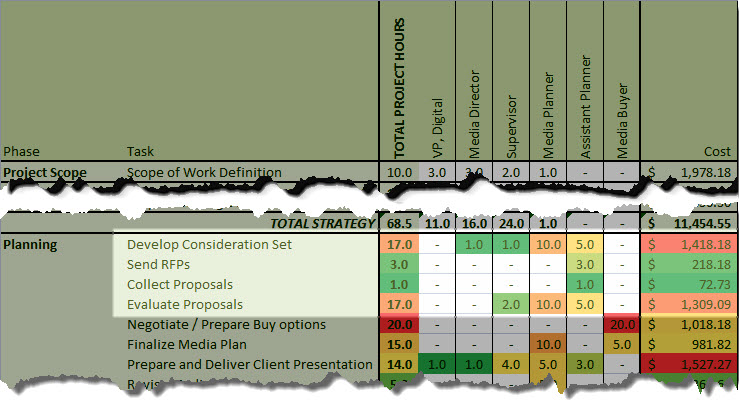
Here’s an interesting finding from a recent costing analysis: Digital media agencies typically spend 38 hours and $3,018 per campaign executing the Request for Proposal (RFP) process using modern tools.  The “typical” campaign scenario here is a $500k media spend on 10 sites with an average of 10 placements each. In this scenario, time and costs break down as follows:

Is the RFP process broken?  Times have changed since it was built for the Mad Men Era: budgets are smaller and cycle times are quicker. It seems a new approach is required for the digital age.

Widgets for Mailing Lists?

September 20th, 2011

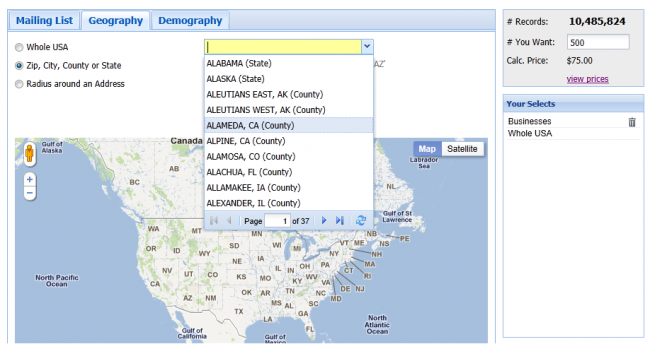
While renting response lists for a direct marketing campaign may be a complicated process, the acquisition process for compiled lists is pretty simple nowadays. Companies like LeadsPlease have actually automated and ‘widgetized’ the mailing list selection and purchase process online. Tools like this are great for local businesses looking to target specific zip codes with a saturation mailing. There’s no need to over-complicate that process, since the data is compiled and, unlike with response data, there are minimal requirements for list owner approval.

If you are a list or data compiler and would like assistance with this kind of integration, let us know and we’ll work with you to get connected.

The DataWidget

The DataWidget

Only 3% of CMOs Say Their Agency Drives Innovation

September 19th, 2011

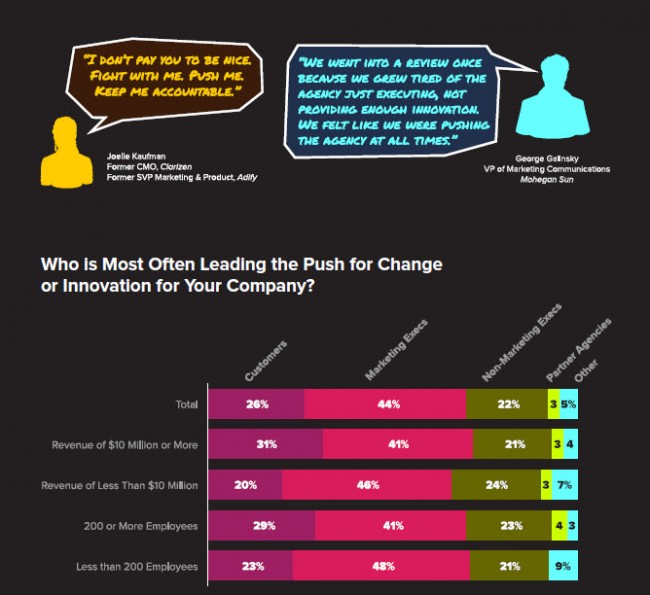
According to a new study by the Horn Group and Kelton Research, CMO’s prefer agencies who work as a partner versus a vendor.  Yet, only 3% feel their agencies often lead the charge in company innovation:

Furthermore, 68% of CMOs feel their agencies are behind the curve on digital interactive media integration.

My key takeaway is that CMOs are looking for help and there’s a big opportunity for agencies who rise to the challenge.  You can find the full report here: The CMO Challenge.

We’re hiring — Inside Account Manager

September 16th, 2011

We’re looking for an experienced Inside Account Manager to join our sales team.

This person will be responsible for establishing, developing, and managing relationships with website publisher, advertising agency, and media broker/management clients.

Click here for the full job description

NextMark Release Improves Usability

September 8th, 2011

This evening, we will update the NextMark system to version 7.11.  The release is packed with changes aimed at making the system easier to use and more reliable than ever.

The most significant change you’ll see relates to the new Data Card Wizard that not only makes it easier for users to add and edit data cards but also enables a new type of data card format for advertising programs.  The data card format is determined by the Media Type, which is chosen on the first panel of the Wizard (see example below).


As you’ll soon see, it is now easier to navigate to specific section of existing data cards and make changes quickly.

Another new feature that reduces the amount of time you’ll spend updating data cards is batch update of key dates.  Now, from a search results page, the ‘valid as of’ and ‘last update’ dates can be updated and applied to one or more records displayed on the page.

So, log in and check it out and for a complete list of changes in 7.11, refer to the release notes.

Typical Online Display Media Order Process

September 1st, 2011

As part of the process of building our next generation digital media planning application, we’ve been documenting the current digital media “culture” (I feel like an anthropologist). One of the more interesting documents to come out of this research is the “Typical Online Display Media Order Process” shown here:

Typical Online Display Media Order Process

This is complicated! You’ll find a dozen roles executing 42 steps.  It’s no wonder the cost of executing a digital campaign is so high.

Creating Media and List Recommendations

August 19th, 2011

When it comes to creating quality media and list recommendations, it helps to have some context for your proposal. Every good media and list recommendation includes the following attributes:  format, content, and insight.

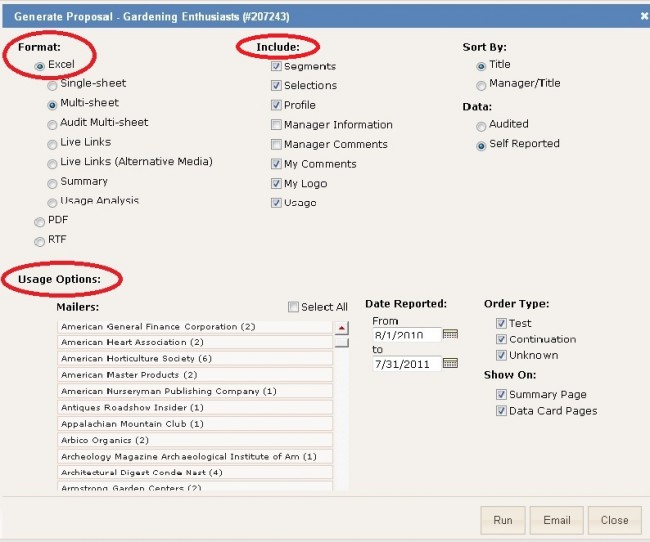
It can be helpful to take a step back and think about how your campaign management tools can help you in the process. For example, the ‘Generate Proposal’ feature in NextMark’s media planning tool can be used as a guide in the preparation of client recommendations. Take a look at the snapshot below for an audience of prospective gardening enthusiasts:

List Recommedation

The format (Excel, PDF, or RTF) allows the creator of the recommendation to determine the level of interaction the end user may have. For example, while a PDF (Portable Document Format) may be appealing, it does not allow for easy editing and customization of the final output. However, a spreadsheet (Excel) workbook can be customized, edited, enhanced, and even integrated with other Microsoft Office programs like PowerPoint. It provides a lot of flexibility, not only for viewing but also for analysis.

And of course, there is also the RTF (Rich Text Format) which is easily read by Microsoft Word. While this may be a common format among traditional direct marketers, it provides fewer benefits due to the limitations of word processing applications. The content of data cards varies due to the depth and breadth of each media program or mailing list. This creates issues related to pagination and alignment that can be more easily resolved with alternative output formats.

The content options enable the creator to generate media and list recommendations that are relevant, while excluding information that may be considered proprietary from a media brokerage perspective. For example, a recommendation made by a list broker for a catalog marketing client may include additional segements, selects, and profile information for discussion purposes related to refinement and targeting. However, the manager information may be suppressed intentionally to keep focused on the value that the media broker brings to the campaign management process.

Additional insight may be applied as well. With access to the mailer usage database, media brokers can also leverage the experiences of others and help speed up the decision-making process. It’s a great way to uncover new media to test based on what has worked for others. It is often the not-so-obvious recommendations that outperform the market average for response and lifetime value (LTV).

Keep these three things in mind as a guide for media and list recommendations, but don’t feel like you need to change your personal style. What’s most important is what sets you apart as a trusted advisor for your clients.

Hope this was helpful…

Chris

NextMark Releases 2Q11 Data Card Quality Report

July 12th, 2011

Hanover, NH – July 13, 2011 – NextMark, Inc. a leading provider of direct marketing tools and resources, today published its second quarter 2011 Data Card Quality Report. The report categorizes list management firms based on the number of titles managed, and provides an average data card quality score across each company’s list management portfolio.

Among the findings were 16 list management companies that posted double-digit improvements when compared to the first quarter of 2011. A total of 89 list management companies got an ‘A’ (90.0 or greater) for data card quality in Q2 2011, and 25 of those companies got a perfect score (100).

It is important to note that data card quality does not reflect list quality, but it does measure the completeness and recency of information about the list. This helps to ensure that direct marketers have the information they need to make good prospect list purchasing decisions.

NextMark publishes the top 50 ranking report on a quarterly basis. The next report will be published in October 2011.

Individual data card scores are calculated using a weighted average of thirteen attributes, with an emphasis on recent updates. A list manager’s score is the average of all the data card scores in their portfolio. The first quarter 2011 Data Card Quality Report includes a ranking of list management companies by data card quality.  The top companies for each category are listed below:

Category I (500+ Titles)

American List Counsel
B2B
Complete Mailing Lists
ListBargains.com
Lighthouse List Company

Category II (250 – 499 Titles)

ConsumerBase
Media Source Solutions
Dunhill International
Great Lakes List Management
List Connection, Inc.
PCS Mailing List Company
Take 5 Solutions
Ethnic Technologies
Integrated Business Services

Category III (100 – 249 Titles)

W.S. Ponton
BMI Elite
eTargetMedia.com
List Service Direct, Inc.
Political Fundraising Lists
Charles Moore Associates

Category IV (50 – 99 Titles)

Key Marketing Advantage
NCRI List Management
Profile America List Company
Media Baby
Paramount Lists

For a complete report of the top list managers, including risers and fallers, visit NextMark’s web site: http://nextmark.com/media-sales/data-card-quality-report.

About NextMark, Inc.

NextMark’s mission is to help you successfully reach your market. We provide information and technology that powers the market for addressable media and enables media planning, media operations, and media sales. NextMark is a privately held corporation headquartered in Hanover, New Hampshire USA with its Market Intelligence Group located in Edmond, Oklahoma and on the web at nextmark.com.