Blog

Addressable media updates

NextMark's Blog

Recommendations, updates, and thoughts from the NextMark executive team.

Budgeting just got easier with NextMark Planner v1.2

January 29th, 2013

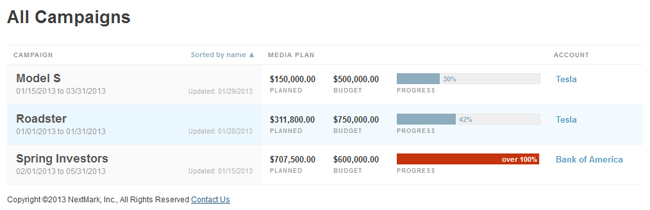
NextMark Planner Budget Overview

Tracking to client budgets can sometimes be a challenge in digital media planning. With the latest release of NextMark’s Digital Media Planner (version 1.2 released Friday, 1/25/13), you now have a handy visualization on your homepage that makes it easier for you to stay on budget on all your campaigns.

Want to get NextMark Planner? Request your free access here.


NextMark Hires Chris O’Hara as Chief Revenue Officer

January 29th, 2013

Chris O'Hara

January 29, 2013 New York, NY – NextMark, Inc. today announced it has hired Chris O’Hara as Chief Revenue Officer. In this newly created role, Mr. O’Hara will lead NextMark’s marketing and sales departments, and manage NextMark’s new regional office in New York City.

“Chris is the ideal person for this role,” said Joseph Pych, NextMark’s President. “We were overwhelmed with 102 applications for the job. Chris stood out from the rest of the pack because he’s not only got the right sales management skills, but also has extensive industry experience and the right ideas to lead our new growth in digital advertising.”

Mr. O’Hara was most recently Chief Revenue Officer for Looksmart, a search advertising technology company. Previously, Chris has held senior roles at TRAFFIQ, Reviewed.com, MediaBistro, and Nielsen. Chris is a member of American Business Media’s speaker’s bureau, the IAB’s Networks and Exchanges and Sales Executive Committees, and a contributor to industry publications including Business Insider, eMarketing & Commerce, Econsultancy, AdMonsters, MediaPost, The Agency Post, Adotas, ClickZ, iMediaConnection, DigiDay, and AdWeek.

In addition, Chris has published extensive research on the ad technology space, focusing on platforms and technology solutions that drive digital advertising. His recent publications include “Best Practices in Digital Display Media” (Econsultancy, March 2012) and “Best Practices in Data Management” (Econsultancy, December 2012).

“When I saw the NextMark offering, I knew I wanted to join the team,” said O’Hara. “The industry is finally ready to apply real technology to the problem of buying premium guaranteed media, where more than 85% of digital display media spending still resides. NextMark’s tools are the best I have seen, and I am looking forward to getting into the market and giving agencies a way to immediately see improvements in the way they plan and buy media.”

Mr. O’Hara’s hire is effective immediately.

Digital media planning just got even easier

December 19th, 2012

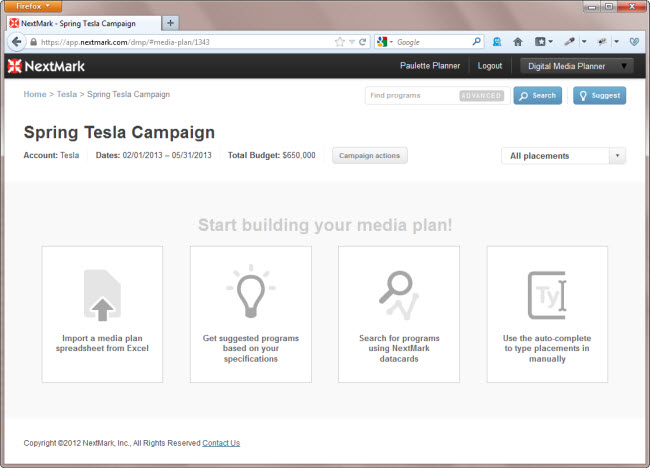
Planner campaign start

Less than three weeks ago, we introduced the new Digital Media Planner tool. It was built specifically to make digital media media planning easy. Today, we upgraded the software to make it even easier. Now when you create a new campaign, you are greeted with four easy options to get started: import a file, suggestion tool, search tool, or type-ahead. In every case, the system is making your life as a media planner easier.

Want to learn more about the tool? Go to http://www.NextMark.com/planner.

iMedia Agency Summit Winners

December 3rd, 2012

imedia-winners

I was sitting at the right table this evening, where all three prizes (3 out of 3) were awarded after dinner at the iMedia Agency Summit in Scottsdale, AZ. Congratulations to Melissa Hogdgon from Engauge whose name was pulled on the first drawing, and chose to receive the iPad mini. It wasn’t shortly afterwards when two other winners emerged from Melissa’s left and right. Congratulations to Scott Atkinson from RedClay Interactive and Kristen Crabtree from Allied Integrated Marketing, who both walked out with great prizes.

As for me, I’m saving all of my business cards exclusively for Digital Media Planners so they can contact me about the ‘Digital Media Planner Happiness Project‘. I’m not so sure I would have had a chance of winning anyway, as something very strange and statistically incomprehensible was happening across the table.

The conference has been great so far, and there are a lot of independent digital advertising agencies who are ready to give their spreadsheets some steroids with Digital Media Planner.

NextMark Aims to Replace Excel With New Digital Media Planner

December 2nd, 2012

Scottsdale, AZ – December 2, 2012 – NextMark, Inc. today unveiled a new system for automating digital media planning workflow at advertising agencies at the iMedia Agency Summit conference in Scottsdale, Arizona. The new system is called Digital Media Planner.

According to NextMark’s research, it costs agencies more than $40,000 per campaign in labor costs to create and execute a digital media plan and executing a digital media plan involves a tedious 42-step process. One of the main reasons for the high cost is the use of Microsoft Excel and manual processes. It’s a process that’s ripe for automation. The promises of workflow automation are to save time, eliminate mistakes, reduce transaction costs, increase agency profitability, and increase employee morale.

However, purpose-built workflow automation systems have so far failed to gain widespread adoption among advertising agencies. A survey of 65 digital media executives at the conference revealed that 80% (52 of the 65) still use Microsoft Excel and manual processes to create media plans while only 20% use a workflow system.  The four main reasons for failed adoption of workflow system alternatives to Excel cited are: too cumbersome, too limited in functionality, too expensive, and not integrated.

NextMark is aiming to replace Excel in the digital media planning process with its new Digital Media Planner system. The Planner is designed for independent digital advertising agencies, but can be used by agencies of all types and sizes. The system is accessed through the web as cloud-based software running on an enterprise-class SAS-70, Sarbanes-Oxley compliant platform.

Joe Pych, CEO of NextMark, unveiled the Digital Media Planner system and demonstrated the its main features at the conference including: importing from comScore Key Measures output; accessing advertising program details such as placements, inventory, rates, and audience profile via its data cards; creating a media plan using an intuitive spreadsheet interface; and exporting to Google’s DFA Ad Server. Mr. Pych indicated the system is available for free.

“Our goal for is to make digital media planning easy,” said Mr. Pych. “It seems like fighting windmills, but it’s about time someone replaced Excel because it causes so many problems and widespread unhappiness among digital media planners.”

Initial reactions to the Planner among conference attendees were positive. “My media planners are going to hug me for bringing this back to them!,” said Melissa Hodgdon, Vice President, Media Director of Engauge.

More information about NextMark’s Digital Media Planner is available on NextMark’s website at http://www.NextMark.com/dmp.

Why is automation important to digital media directors?

December 2nd, 2012

Here is the presentation I gave this morning to a packed room of 70 media executives at the iMedia Agency Summit at the Camelback Inn in Scottsdale, AZ (super nice place btw!):

I presented our research that shows it costs more than $40k to create and execute a digital media plan and that executing a digital media plan involves a 42-step process. This process seems so ripe for automation with the high cost and labor. However, the Media Planning Tools Survey show of hands survey overwhelmingly concluded that Excel is still the top choice among media pros (as I’ve previously blogged). No surprise there… thankfully, because the rest of my presentation depended on that!

Despite the volume of screen shot slides in the presentation, I did rapid-fire 8-minute flyover of our newest creation: the Digital Media Planner system. We just launched it two days ago. This is the first time I’ve shown it off in public. I thought the iMedia Agency Summit was the perfect venue for the reveal since it is designed specifically for media planners at independent agencies. We structured our development timeline to launch in time for the conference.As always, our fantastic development team hit their dates (we’re big on shipping on time).

Being the first public reveal of the Digital Media Planner, I was afraid nervous nobody would like it. But based on a show of hands survey, virtually everyone did like it. Yay! So, that gave my ego a big boost (although maybe they were just being nice to me because I bought them all breakfast).

Why is automation important?

The main part of the session was to ask the audience the question: “why is automation important?” in digital media planning. Hands went up and I heard lots of smart answers, including roughly in this order:

  1. “profitability – the faster we can get things done, the more business we can take on”
  2. “efficiency – faster workflow – automation makes it easy to make on-the-fly changes quickly”
  3. “streamlining the process”
  4. “minimizes risk and human error”
  5. “media planner happiness”

I was pleasantly surprised that “profitability” was the first answer within two milliseconds. Most think “efficiency” first and business growth comes after a few minutes.  Lack of automation is clearly holding back both the top and bottom line at digital agencies. I’m glad someone answered “happiness” because that’s what it’s all about IMHO (and because I littered the place with “happiness” mugs). You find happiness is the core value of automation when you repeatedly ask why. And that’s why we internally call the development of the Digital Media Planner system, the “Digital Media Planner Happiness Project.”

Besides the free food, everyone at the breakfast got a free limited-edition coffee mug, hand-crafted by me. I created the smiley face image by hand using one of my favorite apps on my iPad – Paper by FiftyThree. Below is a picture of the mug as the group was filing in. It says “digital media planner happiness project” on the other side just like on the title slide of the presentation. Let me know if you want one of these mugs – I made 200 and there will be some left over.

Now it’s time to get outside and enjoy the warm, sunny day here in Scottsdale. Speaking of happiness, I’m very happy they hold these conferences at such beautiful places!

NextMark unveils a new Digital Media Planner tool

November 30th, 2012

After two years in the making, I’m very happy to unveil our latest creation: the Digital Media Planner – a system specifically designed to help digital media planners to get their job done more easily.

The 42-step process to create and execute the digital media plan costs agencies an average of $40,000 per campaign in labor costs. This cost does not include creative, technology, or other costs to deliver  the campaign. Just the media department labor cost. It’s a very expensive process.

The digital media planning process is ripe for automation because of the combination of high costs and repetitive, manual labor. However, prior solutions have failed to gain widespread adoption in the marketplace.  Despite the availability of various workflow systems, the digital media planning process is still typically done manually using Excel, email, shared drives, and generic tools. In our research, we discovered the reasons for system adoption failure were a combination of the following factors: (1) too cumbersome (2) too expensive (3) too limited in functionality or (4) not integrated.

With that in mind, we took a fresh approach to solving this problem this problem. Read the rest of this entry »

The Digital Media Planner Happiness Project

November 29th, 2012

As I talk about the automation benefits of our Digital Media Planner system, I use words like “easy, efficient, and effective.”  But these words don’t capture the essence of what we are doing here from a media planner’s perspective. Here I try to get to the essence using the 5 whys method with a fictitious media planner, Paulette Planner:

Why is workflow automation important in digital media planning?

Paulette Planner: “Because it frees me from doing lots of mundane, robotic tasks like copying and pasting 600 placements from Excel into DFA.”

Why is liberating you from mundane, robotic tasks important?

PP: “Because it saves me time, eliminates tedious mistakes, and let’s me spend more time on higher-value, strategic activities.”

Why is spending your time on high-value activities important?

PP: “Clients pay for value. If I’m doing valuable work, then I’ll be happier with my job. Plus, I’ll get paid more and get promoted.”

Why is your happiness important to the agency?

PP: “I do better work when I’m happy. Clients are happier with the results and the agency gets more money. I’ll see a better career path here and stay here longer. This is why I got into advertising.”

So, ideally, automation leads to your happiness and better results for your agency. It seems we should call our media planning system development effort “The Digital Media Planner Happiness Project.” We’ll know we’re successful when media planners tell us the system makes them happier.

3 Reasons Why “Programmatic Premium” Doesn’t Work Today

November 7th, 2012

This article was originally published in The Makegood.

There’s been a lot of discussion lately about “programmatic premium” – using machines to fully automate the purchase of premium advertising inventory. It seems like every conference lately has someone from Kellogg’s on a panel saying programmatic premium is GR-R-REAT with very impressive statistics to support their claims.

The Ad Exchanges, DSPs, DMPs, SSPs, and various other TLAs (three letter acronyms) you see on Terry Kawaja’s Display Lumascape have certainly been successful at automating the buying and selling of remnant inventory. But remnant inventory represents only a small slice of advertising spending. According to Mike Leo, CEO of Operative, only 18% of digital media advertising budget is spent through exchanges.

Advertising technology stack vendors are now hungrily eyeing the other 82% of the pie that is currently being spent on premium advertising inventory through guaranteed contracts. Their story is their technology will work just as well for premium inventory as it has proven to be for remnant inventory. However, in practice, they face three very significant challenges.

First and foremost, today’s exchange-based technologies are not well-suited for buying guaranteed inventory. Exchange-based technology was built to optimize bids on an impression by impression basis in real-time. The lifecycle of the process is literally 30 milliseconds and does not involve humans. It’s just a simple transaction between two computers based on pre-programmed bidding algorithms.

In contrast, buying guaranteed inventory today is a messy 42-step process spanning weeks involving humans from multiple organizations, RFPs, dinners, ballgames, proposals, contracts, negotiations, reviews, signatures, and such. The big problem/opportunity with buying guaranteed inventory is not in optimizing bids, but rather in optimizing the workflow. Optimizing workflow within the agency and among trading partners requires a very different set of technologies than an algorithm for optimizing bid prices on a transaction.

To avoid all this messy workflow, some ad tech vendors ignore it and try to force-fit premium inventory into exchanges. They want to move the inventory into the game they are already good at playing.

That leads to the second problem: premium publishers don’t want to put their inventory in exchanges because it drives down the value of their inventory. Publishers joke that RTB really stands for “race to the bottom.” According to Walter Jacobs, EVP of Sales at Turner Digital “We don’t participate in any real time bidding or private exchanges at this point. It’s a very funny thing, because to the untrained eye, we might seem like an unsophisticated old media company that is scared to embrace technology. The opposite couldn’t be much closer to the truth. […] We believe the downside of RTB and private exchanges is that it fragments audiences.”

Ad tech vendors need to respect the needs of the premium publisher. Publishers are certainly keen to streamline their workflow, lower their transaction costs, and to make it easier to buy from them. However, they will never do that in an environment that commoditizes their inventory and creates channel conflict with their ad sales teams.

A third problem that is rarely mentioned, but perhaps trumps them all is the dirty secret that advertising agencies are making a ton of money on the old way of buying guaranteed inventory. Starting around 1990, agencies have moved from media commission models to hourly (or “cost plus”) pricing models. According to the 4A’s Labor Billing Survey Report, 91% of proposals today are priced based on hourly rates (despite scoring lowest among alternatives on the Grossman Grid). In other words, the more time they spend on a job the more they get paid for the job.

A typical digital media plan costs an agency $40,000+ in labor to create and execute. These costs plus a profit margin are the revenue for the agency. As such, agencies are reluctant to adopt technologies solely on the basis of efficiency because it will cut their revenue. As an engineer, it kills me there’s a disincentive to be more efficient. But that’s the cruel reality of the situation. Any new technology has to have value beyond just efficiency to give the agency a really good reason to break rank and to go through the painful process of establishing a new compensation model that preserves their revenue.

There’s a billion dollar opportunity for automation in premium inventory. Ad tech stack vendors have proven that automation works in remnant inventory. Now it’s time to raise the bar and evolve the automation to support the more sophisticated needs of the buyers and sellers in premium advertising inventory.

NextMark hires Weiping Liu as Director of Software Engineering

November 7th, 2012

We’re happy to announce that Weiping Liu has joined the NextMark team as our Director of Software Engineering. In this role, Weiping will be leading the software team in building software for buying and selling media for advertising. He’s joining us at a very exciting time – just as we’re putting the finishing touches on a brand new product – a digital media planning system (we’ve yet to come up with a fancy name for it).

Weiping has more than 20 years experience building software. As a hands-on manager with a keen focus on shipping, he’ll fit right in with our lean, maker culture. Prior to NextMark, Weiping has worked with some of the great software companies here in the Upper Valley such as TomTom, isee Systems, Tally Systems (Novell), High Performance Systems, and Concepts NREC. Weiping holds a Master’s Degree from Dartmouth College and a Bachelor’s Degree from Beijing Normal University.