Blog

Addressable media updates

NextMark's Blog

Recommendations, updates, and thoughts from the NextMark executive team.

If it’s not Programmatic Premium, then what is it?

April 9th, 2013
CountryAndWestern

We got both kinds…programmatic RTB and programmatic direct!

This article originally appeared in ClickZ.

I recently returned from an exciting IAB Annual Leadership Meeting in Phoenix, where a packed Arizona Biltmore resort was host to over 800 digital media luminaries. On the tip of many tongues over a two day session was “programmatic premium,” the term our industry is using to describe the buying of digital media in a more automated way.

One particular “Town Hall” type meeting was particularly spirited, as leaders sparred over what “programmatic” meant, whether or not publishers should be using it, and how agencies were leveraging it. Here is what I heard:

We are calling it the wrong thing. Like it or not, the term “programmatic” is tied to the concept of real time bidding. This is natural, given the fact that the last 5 years in ad tech have largely revolved around DSPs, SSPs, and cookie-level data. This creates a problem because, when you add the word “premium” into the mix, you have a really big disconnect. Most folks don’t really consider the large majority of exchange inventory “premium.” Doug Weaver said we should just call it “process reform,” since we are really talking about removing the friction from an old school sales process that still involves the fax machine. Maybe the term should be “systematic reserved” for deals that happen when guaranteed buying platforms (like NextMark, Centro, and MediaOcean) plug into sell-side systems (like iSocket, AdSlot, and ShinyAds) to enable a frictionless, tagless, IO-less buy. It is early days, but I suspect this may be what people are talking about when they utter the term “programmatic premium.”

Private Exchanges Seem like a Fad. For programmatic premium to take off inside of RTB systems, something like having “Deal ID” and “private exchanges” need to be implemented at scale. Yet, for all of the conversation around programmatic premium, I heard very little about private exchanges, Deal ID, and the like. I really think this is because of publishers enjoy having RTB as a channel for selling lower classes of inventory. They are getting better average CPMs from SSPs than they were getting in the network era, and they can experiment with who gets to look at their various inventory and play with floor pricing—a much higher level of power and control then they recently enjoyed. But do they want to sell the good stuff like this? The answer is no. They do, however, want to find ways to get out of the RFP mill that makes the transactional RFP business they manage so cumbersome and people-heavy. Again, that seems to be in the domain of workflow management tools, rather than existing supply-side platforms. If any of the many publishers at the conference were leveraging private exchanges to sell double-digit CPM inventory to a select group of customers via RTB, we didn’t hear a lot about it.

Agencies Love Programmatic. We heard programmatic perspectives from many major agencies throughout the conference, mostly in bite-sized chunks in networking sessions. When asked whether large agencies had less of an incentive to create efficiency in media planning and buying (since they get paid on a cost-plus basis), some agency practitioners admitted this was true but offered that “times were changing quickly.” Clients, having access to many highly efficient self-service buying platforms for search and display (and some, like Kellogg Company, having their own trading desks) there is a lot less tolerance for large billable hours related to media planning. It makes sense; the easier it is to plan a campaign, the cheaper it should be. Marketers would like a bigger chunk of their money going to the media itself. That said, we also heard that agencies are being pushed hard on meeting KPIs—and that even goes for brand marketers. Meeting those KPIs is easier to manage in a programmatic world, and that means pressure to buy through DSPs, rather than emphasizing guaranteed buys. That means lower prices for publishers, and probably necessitates plugging higher and higher tiers of inventory into RTB systems.

We Got Both Kinds

Like the honkytonk saloon in the Blues Brothers that offers “both kinds of music—country and western,” we have to accept two types of “programmatic premium” right now. The first is the notion of buying real premium inventory inside of today’s RTB systems through private exchanges. The second is the notion of buying reserved inventory in a more systematic way. Both approaches are valid ways in which to create more efficiency, transparency, and pricing control in a market that needs it. We just have to figure out what it’s eventually going to be called.

 

RFP Template for Digital Advertising

April 5th, 2013

request-for-proposal

After speaking with dozens of digital media publishers and planners, I’ve come realize that two things need to happen in order for more digital media proposals to be accepted:

1) The digital media planner (buyer) must communicate the campaign objectives, acceptance criteria, and detailed requirements in a manner that leaves no room for error or misunderstanding.

2) The digital media publisher (seller) must respond with a relevant proposal that includes all of the requested information. Take a look at the top 5 things you’ll find in digital media proposals that win.

The good news is that digital media spending continues to increase, and you can expect to see an even greater lift in demand for premium guaranteed inventory when interactive media buyers and sellers are effectively matched, consistently concise, and clearly understood.

Based on input from digital media buyers who have expressed their needs, I developed an EASY-RFP template using the desktop application most frequently used in 2012 by digital media planners; that’s right — Microsoft Excel!

I would like to thank Ali Hockenberry (IMM), Ed Frack (Klunk & Millan Advertising), Joel Nierman (Critical Mass), and Michelle Burnham (Burnham Marketing) for their insights and RFP template suggestions.

Click here to download your free RFP template for digital advertising. Feel free to use, modify, or incorporate this for your own RFP template. Your feedback is welcome!

You can use the Easy RFP template in conjunction with NextMark’s Digital Media Planner application. Planner eliminates the hassles associated with sending RFPs, managing proposals, and accepting proposals into your media plan.  Best part? It’s free. Request your access to NextMark Planner here.

When Cost-Plus is a Minus

April 4th, 2013

images

[This post originally appeared in ClickZ.

It’s funny how people deride Microsoft for not being successful in advertising technology when 80% of digital media dollars are transacted using their media planning software. Despite the fact that we live in a world where computers can evaluate hundreds of individual bid requests on a single impression and render an ad serving  decision in under 50 milliseconds, the overwhelming majority of display inventory is bought using e-mail and fax machines. Those media plans are manually created in Excel.

Terence Kawaja of the famous  LUMAscape maps, which depict the 300-plus companies who enable the 20% of display buying that happens programmatically, once said that “inertia is the agency’s best friend” when asked why holding companies were not doing more to bring innovation to advertising. I imagine that part of what he meant was that their common business model (billable hours plus a negotiated margin) does not create an incentive for efficiency. On the contrary, complexity in media planning means more billable hours—as well as a built-in need for agencies’ existence. After all, if media buying were easy, then marketers would do it themselves.

A result of this inertia is the fact that Microsoft’s business products (Outlook, PowerPoint, and Excel) power the majority of digital media buying today. After research is done in platforms like Comscore and Nielsen, media planners output a spreadsheet, create an RFP, and begin the long process of gathering other spreadsheets from publishers. After a few weeks and $40,000 in hours spent cutting and pasting, a media plan is born. This grueling process has the average media planner spending more time on manual, repetitive processes than on strategy and high-value, client-facing activities. You would imagine that agencies would work quickly to adopt technologies that make the transactional nature of media planning more streamlined.

It seems like agencies don’t care, as long as they are getting paid for their work, but there are real problems with the Excel model. Here are a few to consider:

  • Employee Happiness: One of the biggest problems facing agencies is the constant turnover in media planning departments. Agencies hire junior planners directly out of college in many cases, and work them long hours where they perform many of the manual processes that go into digital media plan execution. After a while, they take their training and insights and ascend the ladder into the next position, or take their newfound expertise to the next agency, where they can expect more of the same for a slight raise. Wouldn’t it be better to deploy technology that takes out the grunt work of campaign planning, and enables planners to focus on more high value activities, such as strategy? The costs of employee turnover are high, as are the hidden costs of employee dissatisfaction.
  • More Bandwidth Equals More Clients:  Although agencies get paid for their hours, there is a point at which an agency can only take on so many clients. After all, adding employees (even low cost ones) means adding more desk space, furniture, computers, and financial overhead in general. Eventually, an agency starts to need increases in productivity at the employee level in order to scale, and add more clients (and revenue) without overly expanding its physical footprint. Leveraging technology that streamlines the manual part of media planning means being able to do more planning with less planners, enabling shops to scale their market share without adding as many junior personnel.
  • You Don’t Get Paid for Pitching: Digital media shops don’t always get paid for all of their hours. Pitching new clients means creating sample plans and putting company resources to work on speculative business, which is all the more reason to find efficiencies in media planning technology.
  • Spreadsheets Don’t Learn: One of the biggest problems with digital media planning using manual, spreadsheet-driven processes is that it becomes hard to maintain a centralized knowledge base. Planners leave, plans get stored on disparate hard drives, information on pricing and vendors is fragmented, and it is hard to measure performance over time. Despite the fact that they are getting remunerated for their work, agencies must consider whether the method of using man hours to perform repetitive tasks could be more expensive in the long run. As David Kenny once remarked, “If you are using people to do the work of machines, you are already irrelevant.”

At the macro level, the cost-plus pricing model’s principle disadvantage is that it creates what economists call a perverse incentive or, put more simply, an incentive for inefficiency. When it that cost model is applied to digital media planning—already fraught with inefficiency—you have an environment ripe for disruption. The advent of new, platform-driven media planning and buying technologies is spawning a new era of “systematic guaranteed” buying which promises to streamline and centralize the way banner ads are bought today. Agencies will be able to dedicate more hours to client facing tasks and strategy, and publishers will be able to manage their transactional RFP business more seamlessly, and be able to focus their sales teams on super premium, high CPM sales.

By eliminating much of the human cost of media planning and buying, technology can help add more value to the media itself—the real “plus” that we have been looking for.


A Publisher’s History of Programmatic Premium

April 2nd, 2013

Evolution

This article originally appeared on in AdExchanger.

It’s hard to argue that the banner ad era has been good to publishers. After a brief initial period in which banner inventory matched audience availability, publishers enjoyed double-digit CPMs and advertisers enjoyed unique access to a valuable audience of online “early adopters.” Prognosticators heralded a new golden era of publishing, and predicted the eventual death of print. Fifteen years later, print is barely breathing, but publishers are still awaiting a “golden era” where the promise of online media matches its potential. What happened on the long road of publisher monetization, and how did we arrive in this new “programmatic” era?

It didn’t take long after HotWired sold the first banner ad to AT&T for other online properties to start making banner ads part of every page they put onto the Web. Not immune to Adam Smith’s economic theory, banner CPMs lowered as impression availability rose. Suddenly, publishers were in the single digits for their “ROS” inventory, and had plenty of impressions left over every month. Smart technology companies like Tacoda saw an opportunity to aggregate this unsold inventory, and sell it based on behavioral and contextual signals they could collect. Thus, the Network Era was born. Because networks understood publishers’ audiences better than the publishers did, they were able to sell ads at a $5 CPM and keep $4 of it. That was a great business for a very long time, but is now coming to an end.

While not creating tremendous value for publishers, the Network Era did manage to pave the way for real time bidding, and the start of the Programmatic Era. Hundreds of millions of cookies, combined with a wealth of third-party data on individuals, presented a truly unique opportunity to separate audiences from the sites the visited, and enable marketers to buy one impression at a time. This was great for companies like Right Media, who aggregated these cookies into giant exchanges. For advertisers, being able to find the “auto intender” in the 5 trillion-impression haystack of the Web meant new performance and efficiency. For publishers, this was another way to further segregate audience from the valuable content they created. The DSP Era ensured that only the inventory that was hardest to monetize found its way into popular exchanges. Publishers ran up to a dozen tags at a time, and let SSPs decide which bids to accept. Average CPMs plunged.

Over the last several years, it seems like publishers — at least those with enough truly premium inventory — are fighting back. Sellers have brought programmatic efficiencies in two ways: implementing DMP technology to manage their real programmatic (RTB) channel; and leveraging programmatic direct (sometimes call “programmatic premium”) technologies to bring efficiencies to the way they hand-sell their guaranteed inventory. Let’s look at both:

  • Programmatic/RTB: Leveraging today’s DMP technology means not having to rely on third-parties to identify and segment audiences. Publishers have been trying to take more control of their audiences from day one. The smartest networks (Turn, Lotame) saw this happening years ago and opened up their capabilities to publishers, giving them the power and control to sell their own audiences. With the ability to segment and expand audiences, along with new analytics capabilities, publishers were able to capture back the lion’s share of revenue, previously lost to Kawaja-map companies via disintermediation.
  • Programmatic Direct: Although 80% of the conversation in publisher monetization has revolved around the type of data-driven audience buying furnished by LUMAscape companies, 80% of the display advertising spending has been happening in a very non-real-time way. Despite building enough tech to RTB-enable the globe, most publishers are selling their premium inventory one RFP at a time, and doing it with Microsoft Excel spreadsheets, PowerPoints, PDFs, and even fax machines. RTB companies are trying to pivot their technology to help publishers bring efficiency to selling premium inventory through private exchanges. Other supply-side companies (like iSocket, ShinyAds, and AdSlot) are giving publishers the tools to sell their premium ads (at premium prices) without bidding—and without an insertion order. On the demand side, companies like Centro, Facilitate, MediaOcean, and NextMark (disclosure: I work there) are trying to build systems that make planning and buying more systematic, and less manual.

As programmatic technology gains broader acceptance among publishers, they will find that they have turned the monetization wheel 180 degrees back in their favor. DMP technology will enable them to segment their audiences for targeting and lookalike modeling on their own sites, as well as manage audience extension programs for their clients via exchanges. They will, in effect, crate a balanced RTB playing field where DSPs and agency trading desks have a lot less pricing control. Programmatic Direct (or, more correctly, “systematic reserved”) technologies will help them expose their premium inventory to selected demand side customers at pre-negotiated prices, and execute deals at scale.

The Programmatic Era for publishers is about bringing power and control back into the hands of inventory owners, where it has always belonged. This will be good for publishers, who will do less to devalue their inventory, as well as advertisers, who will be able to access both channels of publisher inventory with greater efficiency and pricing transparency.

New Tech Takes On Cost-Plus Pricing by Agencies

March 26th, 2013

compensation

This article was originally published on the CMO site.

How the enterprise pays its ad agency actually matters. Here’s why.

I have been working for a company that makes software solutions for buying digital media, and I have worked for a number of ad technology companies in the past. In a world where digital banner ads are still purchased through email and fax, and media plans are mostly created using Microsoft Excel — technology dating from 1985 — the ad technology industry sees an opportunity to create efficiencies in the way media is bought and sold.

One of the odd industry dynamics we have encountered in bringing our product to market is how independent agencies are more apt to embrace new efficiencies than some of the “big four” owned agencies that lead the space in terms of media spend.

Logically, you’d think that gigantic media agencies, managing hundreds of media planners and buying on thousands on digital media channels, would grasp at the chance to do more planning with fewer personnel, migrating towards web-based tools that offer efficiency and centralization. The evidence has shown otherwise.

On the surface, it may seem as though the biggest difference between independent agencies and the majors is size. The majors have Ford, and the independents have the Ford dealers. They both work very hard to identify digital audiences, perform against marketers’ aggressive KPI goals, while trying to understand how they got there through detailed analytics. At the core, the difference between what media teams within holding company shops and a smaller agency does is minimal. So what accounts for the reluctance of bigger shops to innovate with technology tools?

One reason may be the way they get paid.

The biggest shops consistently rely upon cost-plus pricing, which pays them based on hours worked, plus an additional, negotiated margin. The typical $500,000 digital media plan takes an alarming 42 steps and nearly 500 man hours to complete, which can cost up to $50,000 — and that doesn’t even include developing the creative.

If you are paying your agency on a cost-plus basis, your agency doesn’t have a lot of incentive to create your plan faster, or with less labor. In fact, this type of pricing scheme creates an incentive for inefficiency, or what economists call a “perverse incentive.” Unfortunately, every cent you pay towards the labor of creating a media plan subtracts from the amount that can be dedicated to the media itself.

Spend

So, what to do? The most obvious choice for those working with a large agency under such a scheme is to try and change the payment terms. Pay-for-performance is optimal, but a careful analysis may show that paying on a percentage-of-spend model yields more reach, when you are not paying for the labor of building a media plan.

Some marketers are choosing instead to build small, efficient in-house teams to leverage the demand-side technologies that their agencies want to discover and buy digital media. Other marketers choose to work with multiple smaller, independent agencies that have specific expertise in different digital verticals. Those shops usually offer flexible fee structures, and you are far more likely to work with the team that pitched you after you hire them.

As they say in finance, it isn’t what you make, it’s what you keep. In digital media, moving away from cost-plus pricing relationships and towards new technologies for media buying means keeping more of your money for reach, and spending less on labor that doesn’t help you move the sales needle.

What We Love, Hate and Desire in Our Digital Media Jobs

March 20th, 2013

This presentation was given by Joe Pych at Digiday Agency Summit March 20, 2013 in Scottsdale, AZ. Two thirds of people in digital media plan to change jobs in the next two years because they are unhappy. This survey reveals the source of unhappiness and makes recommendations to increase job satisfaction.

To get a more detailed look at the findings, download the DAS SOTI March 2013 Happiness White Paper.

Shameless self-promotion: Among many other things, this survey revealed that 76.1% of agencies use Microsoft Excel to create their media plans.  It also revealed that 59.4% are not happy with their tools.  Are you unhappy with wasting your life away in Excel? You should try NextMark’s Digital Media Planner tool. It’s free and better than Excel in at least 31 ways.

Media Planning in Excel is a Fool’s Errand

March 6th, 2013

Yesterday, in a call with an agency president she said, “media planning in Excel is a fool’s errand.” This got me thinking about all the ways a purpose-built media planning tool like NextMark’s Digital Media Planner system gives a media planner a competitive advantage over those still using Microsoft Excel.

Here’s the list of the advantages (I’m sure I missed a few!):

Advantage Microsoft
Excel
NextMark
Planner
Year built 1985 2013
Create your media plan YES YES
Purpose-built for digital media planning no YES
Built-in media-specific calculations no YES
Easy one-screen interface YES YES
Modern user interface no YES
Media planning dashboard no YES
Clone previous media plans YES YES
Clone rows in a media plan YES YES
Easily import Research from comScore and other tools no YES
Find media programs with search tool no YES
Save time with type-ahead no YES
Get media ideas via suggestion tool no YES
Supports IAB standards no YES
Perform what-if analysis no YES
Link to Publisher data including placements, rates, inventory, and sales contact no YES
Link to comScore data including audience trends, profiles, and cross-visiting no YES
Send Requests for Proposals (RFPs) no YES
Track RFP status online no YES
Receive and manage proposals online no YES
Receive Requests for Consideration (RFCs) no YES
Accept proposals into your plan with a button click no YES
Share your media plan online no YES
Lock your plan while you are working on it no YES
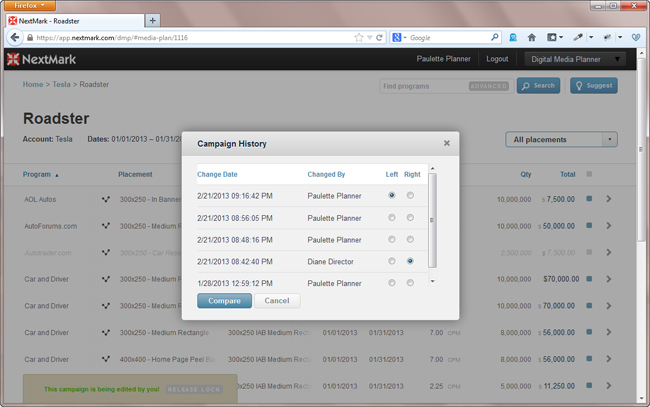
View a full history of changes to your plan no YES
Compare to a prior versions of your plan no YES
Revert to a prior version of your plan no YES
Export Media Authorization no YES
Export Insertion Orders no YES
Export to Google DFA and other ad servers no YES
Integrate with other media tools via APIs no YES
Streamline your media planning process no YES
Get better insights no YES
Position yourself for the future no YES
Price $109.99 FREE

Learn more about NextMark Planner at www.NextMark.com/planner

Collaborate without fear with NextMark’s Digital Media Planner

February 22nd, 2013

nextmark-v1-3-versioning

NextMark today unveiled advanced collaboration features in its Digital Media Planner system. With this upgrade, digital media planners can collaboratively develop digital media plans without fear of losing their work, which is common using today’s solutions.

More than 80% of digital media agencies still use Microsoft Excel to produce their digital media plans. While flexible and easy to use, Excel has a long list of weaknesses that contribute to the high cost to create and execute a digital media plan. Some of Excel’s biggest weaknesses are it’s lack of support for collaboration and version control, which causes lost productivity.

Excel spreadsheets are stored in a file format. As such, only the latest actively saved version is available.  If you forget to save your changes or your machine crashes, your work is lost.  If you and a co-worker unknowingly work on the same Excel media plan at the same time, your work will be lost if he saves his changes after you save yours.  Or you will clobber his work if you save changes work after his. Either way, valuable work is lost. The problem gets worse when you use email to share your Excel media plan because having many files in different places compounds the problem. Good luck trying to merge changes from two or more Excel files; this tedious task takes forever and you’re almost guaranteed to lose some of the work.

Even if you somehow manage to avoid all the file versioning landmines, it’s practically impossible to keep track of all the changes made during the planning process.  When your client asks you “how did this line get into the plan?” you won’t find the answer in Excel.

NextMark’s new Digital Media Planner (v1.3) solves these problems. With Planner, you get the flexibility and usability of a spreadsheet plus a powerful collaboration system. That’s because with Planner your work is always saved securely in cloud database storage with built in collaboration controls:

  1. When you start working on a media plan, you get a lock on the plan so nobody else clobbers your work.
  2. If your co-worker tries to work on same plan at the same time, he sees a warning that you are working on it and is prevented from making changes until you are done.
  3. Your changes are saved immediately as you make them. You don’t even have to hit a save button! (If you’ve ever used Google Docs, you know how handy this can be.)
  4. You can see a complete history of changes to the media plan: when the changes were made and who made each change.
  5. You can easily compare two versions of your media plan and see all the changes highlighted.
  6. If you make a mistake on your plan, it’s easy to revert back to a prior version.

Basically, you’ll never ever again have to deal with a bunch of out-of-synch versions of your media plan. And you’ll never lose your work again.

If you work for an agency that deals with Sarbanes-Oxley compliance or just wants better management controls, the built-in audit trail and comparison features are a godsend.

And, despite all the power of these advanced features, Planner is super easy to use. Even easier than Excel!

Don’t you think it’s time to finally ditch Excel? Want to learn more about how NextMark’s Planner can help you? Request your free access here.

NextMark Opens New York City Office

February 20th, 2013

nextmark-nyc-office-door

NextMark, Inc., a marketing and advertising technology provider, today announced it has opened an office in New York City. The new office, located at 53 West 36th Street, will be managed by recently hired Chief Revenue Officer Chris O’Hara and will be used primarily for sales and service.

“More than ever, having a daily physical presence in New York is important to properly serving our clients,” said Joseph Pych, NextMark’s CEO. “About half of our worldwide client base is in New York and the surrounding metro area. Although we’ve served New York well over the past 12 years, it’s clear we have to ramp up in response to demand for our new products for digital advertising.”

Since its launch less than 3 months ago, more than 75 agencies have started using or are in the process of being set up on the NextMark’s new Digital Media Planner system.

NextMark Helps Raise $300,000 to Fight Breast Cancer

February 19th, 2013

NextMark-Happiness-Project-Bowling-Team-2013

Elizabeth Kim, Mary Bonomo, and Lori Wigler joined NextMark’s “Happiness Project” and 40 other bowling teams to raise more than $300,000 to cure and treat breast cancer during the 4th annual NYC Bowling for Breastcancer.org.

We showed up at Lucky Strike Lanes in NYC on Valentine’s Eve to send some love and support to Breastcancer.org. The NextMark Happiness Project bowled a combined score of 801 and raised a total of $9,230, including the NextMark sponsorship for the event. Mary Bonomo, Managing Partner of Connect NYC, led the pack with the team’s top score. But everyone was a winner: it was an evening jam-packed with free drinks, food, and fun for all who attended.

Special thanks to Leslie Laredo, President of Laredo Group, Richy Glassberg, COO at Medialets, and the rest of the volunteers who made this event a huge success.

Team Roster

Elizabeth Kim, Assistant Brand Strategist, Horizon Media
Mary Bonomo, Managing Partner, Connect NYC
Lori Wigler, Brand Group Director, Horizon Media
Joe Pych, Chief Executive Officer, NextMark
Chris DeMartine, Director of Business Development, NextMark
Chris O’Hara, Chief Revenue Officer, NextMark

Hope to see you next year!  Mark your calendars for February 14, 2014.