Blog

A Strong Case for Direct Mail

Wednesday, March 14th, 2012

By Jim DiProspero, Vice President
Specialists Marketing Services, Inc.

With limited budgets of both time and money, where can I get the most bang for my advertising buck? Business owners continue to ask this question with an increasing volume of choices powered by the proliferation of social media sites and digital advertising opportunities.

Any company seeking new business today has a wide variety of media choices, from print, radio/TV, web sites and social media. Continuing research has shown that one of the most cost effective forms of getting new business is through good, consistent, targeted direct mail. Targeted direct mail lists have several advantages that make them unique. If you know your best customers, then you can use targeted direct mail to reach more of them and generate qualified new business leads. This applies to traditional brick and mortar stores, professionals, or even start up web sites.

Direct mail has the advantage of being perceived as the least intrusive and therefore the most welcome type of advertising. Several studies over the years confirm that most people prefer direct mail to other types of advertising. A recent article, “The Future is Now” in the industry magazine Deliver makes a strong case in support of this. Furthermore, there is less competition in the mail box (due to increasing diversification of marketing budgets online), and this may often lift response.

Unlike an e-mail or SMS text message which can be deleted by the push of a button there seems to be something about a direct mail piece, be it a postcard or a letter that conveys legitimacy on the part of the mailer and encourages the recipient to keep it.

There are a few tried and true techniques that should be employed, or at least tested, on your direct mail campaign

  1. Have a clear call to action. Give your direct mail recipients a compelling reason to contact you.
  2. Make an offer they can’t refuse. Give them something such as a discount or a two for one offer — something to entice them to try your product or service.
  3. Include an expiration date on the offer.

Probably the most important advantage of direct mail is the ability to precisely target audiences better then other forms of advertising. This is due to the lists and data that power its distribution to the right audience. No other channel (online or offline) has the wealth of acquisition data to drive lifetime value (LTV). Although many online advertising sources are real-time, they are often lacking in regards to the big picture of a customer’s purchase (or giving in the case of non-profits) behavior over time.

You may have the most relevant message, and your printing and graphics may be the best money can buy, but the single most important element in the success or failure of your marketing efforts is your selection of the most targeted and appropriate mailing list.

Targeting of your most concise audience is paramount. It many cases it is not enough to target by demographics like age and income you need to target by affinity or interest.

In response to the splintering of the homogenous mass market of yesterday, list marketers have been working at identifying the moving targets and shifting trends of the market place. There are literally hundreds of different lists available to target just about any niche market or affinity group you can think of.

Specialists Marketing Services recently launched a new mailing lists search portal for its Direct Data Division that provides visitors with easy access to rate cards and information about specialty lists and data.

Here you can find an audience for just about any product or service. Keep in mind, you want to reach as many qualified prospects as you can without wasting your message on those who are not interested or can’t purchase your product — targeted direct mail does just that.

If offline marketing with direct mail is not part of your overall mix, then you may be sacrificing LTV at the expense of impressions and clicks. An integrated approach is best.
Data Card Trends for 2012

Monday, January 23rd, 2012

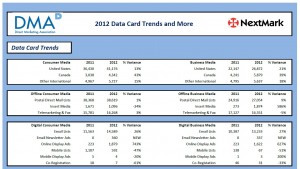
A recent Multichannel Merchant article presents an outlook for digital data to take center stage. While Washington continues to go back to the drawing board to draft new privacy legislation, experienced direct marketers continue to apply online and offline data for responsible direct marketing. For traditional list and data marketing professionals, this creates a need for a new kind of ‘rate card’ or data card for online display advertising. The opportunity to serve this market is open to everyone, and traditional direct marketing services providers have the experience backed with analytical expertise to make a difference.

Data cards are not only available on NextMark, but also on most list management web sites (many of which are hosted via the MarketMax Pro solution). An examples of these are the Parcel Magazine Mailing List and Developerfusion from World Innovators, and Pet Industry TotalBase from List Solutions.

“This online media is no longer new, and should be viewed as an extension of the services that traditional list brokers and managers represent and recommend to their clients,” says Lee Kroll, President, Kroll Direct Marketing.

You can download a free copy of the “2012 Data Card Trends Report” to see how the landscape is changing on our platforms.

Data Card Trends Report 2012

Yikes – it costs an agency $40,356 to create and execute a digital media plan

Wednesday, November 23rd, 2011

There’s been a lot of talk about how inefficient the process of placing digital advertisements is as compared to TV and other traditional media.

For example, according to Google, “Managing display ad campaigns can take up 28% of the budget in overhead, compared to 2% for TV. Which means for every $100 you spend on display, $28 goes to process management such as negotiation with multiple sites, re-planning, faxing insertion orders, trafficking hundreds of ad tags and so on. Such inefficiencies have impeded the growth of the industry.”

Being process and workflow geeks, we wanted to understand this inefficiency at a  deeper level.  So, we conducted our own study to drill into this from a media agency’s perspective.

The goal of the study was to answer a basic question: “How much does it cost an agency to create and execute a digital media plan?

We faced our first big challenge right out of the gate. This question is not as simple as it seems because the cost depends on myriad factors.  When we asked “how much?” the answer we kept getting was essentially, “it depends on so many things I could not tell you.”  Dave Smith of Mediasmith was kind enough to enumerate the 17 factors that influence the cost of a media plan. So, to move forward we constrained the inquiry to a specific scenario of a $500,000 media budget buying guaranteed online display inventory on 10 websites with 10 placements each.

The second big challenge we faced was in calculating and presenting the the findings. Just knowing the bottom line cost does not provide much insight. Knowing what drives the cost is where the insights begin. So, we developed a Digital Media Planning Workflow Calculator which is an activity-based costing model.  We refined this model throughout the process and plugged in the data we gathered from digital media planning experts through our interviews.

Finally, we crunched the numbers.

The answer? It costs $40,356 to create and execute a media plan under the $500k scenario.  This works out to about 8% of media spend.

8% of media spend is much lower than Google’s number of 28%. However, I believe their study covered additional activities such as advertiser, creative, and publisher activities while ours was limited to media activities within the agency.  The 8% seems to be “in the ballpark, but a little low” as we validated the findings.  A rule of thumb is 10-12% of media spend varying by media spend.

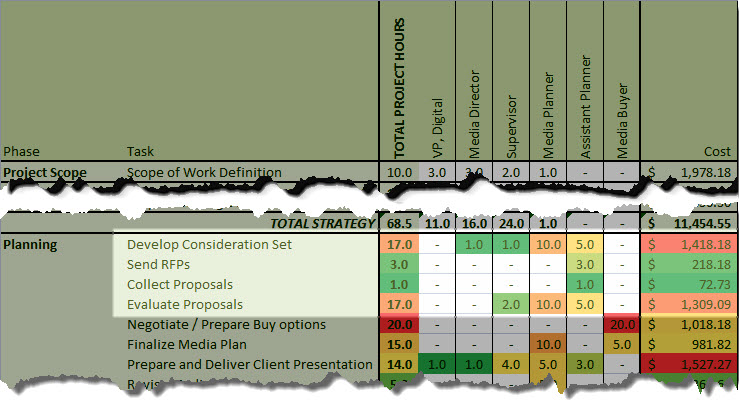
Where does all that money go? We dissected the process by task and by job function and identified the hot spots.  It’s important to know which job functions are performing the tasks because the costs of job functions vary widely (e.g. Media Director versus Ad Trafficker). The reporting phase is the most time-intensive at 113 hours but the strategy phase is the most cost-intensive at $11,454.55 because of the personnel involved.

There is a tremendous amount of manual labor involved in the process of creating and executing a media plan. We counted 482.5 hours per campaign involving 11 different job functions at an agency. That’s a lot of work and people involved!

To get the detailed analysis supporting the result (or to run your own numbers), download the Digital Media Planning Workflow calculator – it’s free and easy to manipulate in Excel.

Present Thinkers Needed for Agency Roles

Friday, September 23rd, 2011

Do agencies need more “present thinkers”? Jason Burnham of Burnham Marketing thinks so. In his recent article “Why Our Industry is a Mess,” he observes:

“We noticed that the majority of our industry is comprised of Past and Future thinkers. There were barely any Present thinkers. The skews were dramatic. To put this into some context, it is Future thinking that drives innovation, the launch of new companies, creativity, sales, and coming up with the “big ideas”. Past thinking drives validation and most likely comprised of our industry’s research and analytics. However, it is the Present thinking that excels at client services, account/project management, strategic planning, operations, systems integration, time management, privacy/data management, process, work flow, budgeting, scope of work, etc. Most of the problems our industry is encountering is due to lack of the right Present thinking attacking these needs.”

The MindTime Framework reveals that present thinkers are good at getting things done. They organize their time and work towards a goal. According to a recent survey, CMOs rate “ability to execute” as their #1 criteria for choosing an outside agency. It’s clear that present thinking people are critical to an agency’s success.

Excel Still Top Tool for Media Pros

Wednesday, September 21st, 2011

Laredo Group‘s AdSavvy newsletter just featured a story by Kendall Allen that hit home with me because it highlights the fact that Microsoft Excel is still the tool of choice for media pros despite the proliferation of other tools:

“Long live the Excel spreadsheet as the tool of choice. We speak anecdotally among industry circles and in class about our seemingly lifelong relationship with manual approaches and tools – and with Excel. We have a love-hate relationship with Excel. It turns out that the stats bear this out. But, we are still more manual and Excel-jockeying than we should be, if we want to scale our efforts.”

She cites research by Efficient Frontier that reveals:

“When asked which tools they used to manage both programs together, US marketers most commonly said spreadsheets (59%)—seemingly favoring a simple, and most likely inadequate campaign management solution over more advanced tools…. That’s not to say that marketers aren’t also relying on some form of analytics or management tool in combination: 48% used a marketing analytics tool, 40% used web analytics tools and about a third of marketers relied on either a third-party ad server, business intelligence platform or their own proprietary internal tool.”

Our own research confirms the widespread use of Excel as the “glue” that holds together the process of creating and executing a media plan. There are many tools used throughout the process that provide sources of data, but the media team turns to Excel bring it all together.

Excel is excellent at providing a flexible and easy to use tool for gathering, organizing, and presenting data. However, it has at least two major drawbacks:

  1. Excel has no media-specific features.  It doesn’t know what a campaign, placement, impression, or click from any other cell on a spreadsheet.  As such, you have to work harder to set up and populate the spreadsheet.
  2. Excel is terrible at storing and re-mixing data.  Sure, you can save your campaign results spreadsheet on your shared drive.  But if you want to know the results for a client over the past two years and that is stored in 50 different spreadsheets, you’ve got a problem.

With our next generation digital media planning tool, we’ve taken on the challenge of building “Excel on steroids.” We want to take the best parts of Excel and extend that with media-specific capabilities that only a database-backed system can provide.

Digital Media Agencies Spend 38 Hours and $3,018 per Campaign on RFPs

Tuesday, September 20th, 2011

Here’s an interesting finding from a recent costing analysis: Digital media agencies typically spend 38 hours and $3,018 per campaign executing the Request for Proposal (RFP) process using modern tools.  The “typical” campaign scenario here is a $500k media spend on 10 sites with an average of 10 placements each. In this scenario, time and costs break down as follows:

Is the RFP process broken?  Times have changed since it was built for the Mad Men Era: budgets are smaller and cycle times are quicker. It seems a new approach is required for the digital age.

Only 3% of CMOs Say Their Agency Drives Innovation

Monday, September 19th, 2011

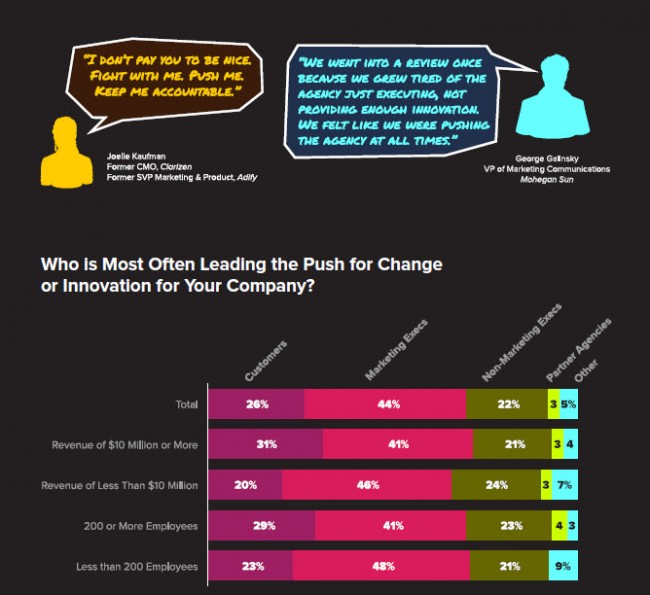
According to a new study by the Horn Group and Kelton Research, CMO’s prefer agencies who work as a partner versus a vendor.  Yet, only 3% feel their agencies often lead the charge in company innovation:

Furthermore, 68% of CMOs feel their agencies are behind the curve on digital interactive media integration.

My key takeaway is that CMOs are looking for help and there’s a big opportunity for agencies who rise to the challenge.  You can find the full report here: The CMO Challenge.

List Industry White Paper

Tuesday, May 24th, 2011

While mailing lists are the lifeblood of direct mail marketing campaigns, the data acquisition process is outmoded. Therefore, NextMark commissioned research to better understand the core issues related to list acquisition and list fulfillment. The Evolution of List Fulfillment is the first whitepaper of its kind, leveraging the combined experience of seasoned direct marketing professionals (list brokerage and management executives), with technological expertise (NextMark) and qualified third-party editorial (Ray Schultz).

Click here to download your free copy of this list industry white paper.

Special thanks to all who contributed to this research product including:

Ray Schultz, President, TellAllMarketing

Lenny Medico, Senior Vice President of List Management, Lake Group Media

Ben Perez, former CEO of Millard Group

Fran Green, President of SMART Data Solutions, ALC

Pete Carney, CEO, Carney Direct Marketing

Geoff Batrouney, Executive Vice President, Estee Marketing Group

David Schwartz, President, Executive Confidential Organizational Consultants

Mary Jo Yafchak, Vice President of Product Management, Acxiom

Don Hinman, Senior Vice President, Epsilon Targeting

Mark Zilling, Senior Vice President, MeritDirect

Charles Morgan, former CEO, Demographics, Inc.

Tom Berger, CEO, Cross Country Computer

Mitch Rubin, CEO, Applied Information Group

David Kanter, President, AccuList USA

Eric Smith, CEO, ListFusion/DataTree

John Papalia, CEO, Statlistics

Carolyn Woodruff, Senior Broker

James Johnson, Advisor, International Direct Response

Lon Mandel, CEO, Specialists Marketing Services

Robert Sher, Principal, RK Sher & Associates

Marlies Duke, Vice President, 4Cite Marketing, LLC

MagnaGlobal predicts digital advertising to grow 18.7% in 2011

Thursday, April 21st, 2011

MagnaGlobal logoAccording to MagnaGlobal‘s “US Media Advertising Revenue Forecast” (as reported by DM news), “Revenue from awareness-driven mass media advertising will grow 10.8% in 2011. Revenue from national digital advertising will grow 18.7% in 2011, driven by strong growth in display, online video and mobile budgets, according to the firm.”

The growth picture for direct media is not so bright:

“Direct media, which the firm defined as Internet Yellow Pages, paid search, lead generation, print directories and direct mail, will perform more poorly than mass media for a second consecutive year. However, direct media advertising revenue will ultimately grow at a greater pace than mass media advertising revenue in the long term, the firm said. Direct media advertising revenue will grow 3.9% by 2016, compared with the 3.7% growth in mass media advertising revenue in that time.”

Direct mail, once again surprises the analysts because it bucks the trend of other traditional media and continues to grow: “Direct mail did a lot better than we thought,” said Feldman. “It will grow each year within the next five years. But compared to electronic media, direct mail and directories are at a disadvantage.”

IAB Reports 2010 Internet Ad Revenues Increased 15% to $26 Billion

Monday, April 18th, 2011

iab logoThe IAB has reported 2010 Internet advertising revenues at a record $26 billion, up 15% from 2009. Fourth quarter revenue also hit new highs at $7.45 billion, up 19% from Q4 2009 and 15% from Q3 2010.

Highlights of the report include:

  • There were record numbers for the yearly advertising revenue as well as record quarterly highs in the Q4 2010.
  • The most popular ad format in 2010 was search which represented 46% of revenue and saw 12% growth from last year.
  • Sponsorships saw the most growth with an 88% increase over last year and 142% increase in the fourth quarter alone.
  • Display-related advertising – which includes Digital Video Commercials, Ad banners/display ads, sponsorships and rich media – continued to grow this year, totaling nearly $10 billion with an increase of 24% over 2009.
  • The results exhibit revenue growth for the past five consecutive quarters.
  • The Annual Report marks the debut of estimated US mobile ad revenue for 2010: between $550 and $650 million.
  • For more information, see iab press release “IAB Reports Full-Year Internet Ad Revenues for 2010 Increase 15% to $26 Billion, a New Record