Blog

5,000+ Top Digital Media Ad Programs Now Available In NextMark

Thursday, April 26th, 2012

NextMark has hit yet another milestone with the Digital Media Advertising Index: more than 5,000 of the top digital media advertising programs are now represented via data cards. It was just four months ago that we hit the 2,500 record milestone. Great momentum!

The top publishers have been very enthusiastic about posting their data cards in the index for four good reasons:
1) It makes it easier for media planners to find them
2) It makes it easier for media planners to buy from them
3) It’s easy to use
4) It’s free

The data card index complements other website indexing services like those from comScore, Nielsen, and Google that to a great job with website metrics such as number of visitors, page views, and basic visitor demographics. Those other services help media planners to find sites on which to advertise, but they don’t answer all questions a media planner needs to know when building a media plan such as:

  • “Does the site accept advertising?”
  • “What more can you tell me about the site and the visitors?”
  • “What are the placement options?”
  • “How much inventory is available?”
  • “How much does it cost?”
  • “Who do I contact for more information?”

Those are the types of questions that are answered on NextMark’s data cards. Data cards have been used by media planners for years in other traditional media channels through SRDS, NextMark, and others. However, it’s been effectively absent from digital media. NextMark is trailblazing this initiative by adapting and evolving the data card concept for digital media.

The goal of the index is simple: to make it easier for media planners to find, compare, and buy digital media advertising programs.

What is the RFC – Request for Consideration (vs. RFP)?

Thursday, March 15th, 2012

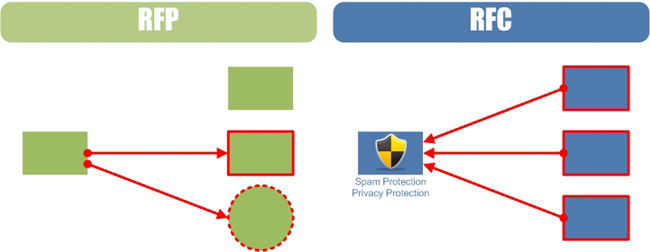
The “RFC” or “Request for Consideration” is new method of media planning that was introduced by NextMark in February 2012. The RFC is an alternative/complement to the “RFP” or “Request for Proposal” process that has been traditionally used in the media buying/selling process.

The RFP and RFC are both methods for match-making among buyers and sellers. With the RFP, the buyer requests proposals from sellers. The RFC takes the opposite approach and turns the RFP process inside out. With the RFC, sellers request consideration from the buyer. In other words, the seller says “Here’s why I think this program deserves to be in your media plan. Will you please consider it?”

The motivation for the RFC is the universal dissatisfaction with the RFP. It seems nobody in digital media likes the RFP.

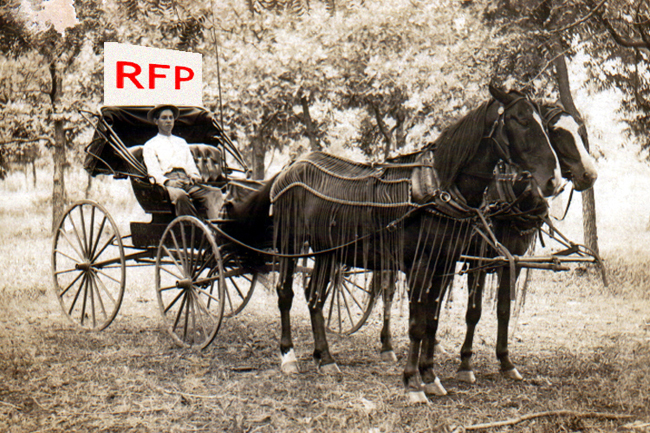
This inspiration for the RFC comes from interviews with buyers and sellers and an understanding of the dynamics of today’s digital media marketplace. The RFP works great in an environment where the options are limited, well-known and relatively static – like TV was in 1962. Fast forward 50 years to today’s digital media and you find the opposite: tens of thousands of options that change every day. It’s virtually impossible for a digital media buyer to keep up with the market and to make efficient and optimal decisions. The RFC addresses this problem by shifting the burden of proof from the buyer to the seller and gives the seller more responsibility in the match-making process.

RFC processThe RFC employs a patent-pending method and protocol between buyers and sellers. The RFC match-making algorithm utilizes NextMark’s proprietary index of the top digital media programs. As you see in the the attached flowchart, the process starts and ends with the media planner. The media planner makes all decisions regarding the media plan.  However, with the RFC the seller has the ability to discover the campaign and make a proposal without requiring the media planner to specifically request it. This opens up the process to both innovation and efficiency. In implementing the RFC, it’s important to include spam controls and identity protection to protect the time of the media planner. Otherwise, more time will be wasted than saved.

The RFC is currently implemented in two commercially available products by NextMark: (1) Media Magnet for media planners and (2) Compass for ad salespeople. Both products access the RFC platform via a web API. The RFC engine and API is available to third party software developers via licensing agreement.

A Strong Case for Direct Mail

Wednesday, March 14th, 2012

By Jim DiProspero, Vice President
Specialists Marketing Services, Inc.

With limited budgets of both time and money, where can I get the most bang for my advertising buck? Business owners continue to ask this question with an increasing volume of choices powered by the proliferation of social media sites and digital advertising opportunities.

Any company seeking new business today has a wide variety of media choices, from print, radio/TV, web sites and social media. Continuing research has shown that one of the most cost effective forms of getting new business is through good, consistent, targeted direct mail. Targeted direct mail lists have several advantages that make them unique. If you know your best customers, then you can use targeted direct mail to reach more of them and generate qualified new business leads. This applies to traditional brick and mortar stores, professionals, or even start up web sites.

Direct mail has the advantage of being perceived as the least intrusive and therefore the most welcome type of advertising. Several studies over the years confirm that most people prefer direct mail to other types of advertising. A recent article, “The Future is Now” in the industry magazine Deliver makes a strong case in support of this. Furthermore, there is less competition in the mail box (due to increasing diversification of marketing budgets online), and this may often lift response.

Unlike an e-mail or SMS text message which can be deleted by the push of a button there seems to be something about a direct mail piece, be it a postcard or a letter that conveys legitimacy on the part of the mailer and encourages the recipient to keep it.

There are a few tried and true techniques that should be employed, or at least tested, on your direct mail campaign

  1. Have a clear call to action. Give your direct mail recipients a compelling reason to contact you.
  2. Make an offer they can’t refuse. Give them something such as a discount or a two for one offer — something to entice them to try your product or service.
  3. Include an expiration date on the offer.

Probably the most important advantage of direct mail is the ability to precisely target audiences better then other forms of advertising. This is due to the lists and data that power its distribution to the right audience. No other channel (online or offline) has the wealth of acquisition data to drive lifetime value (LTV). Although many online advertising sources are real-time, they are often lacking in regards to the big picture of a customer’s purchase (or giving in the case of non-profits) behavior over time.

You may have the most relevant message, and your printing and graphics may be the best money can buy, but the single most important element in the success or failure of your marketing efforts is your selection of the most targeted and appropriate mailing list.

Targeting of your most concise audience is paramount. It many cases it is not enough to target by demographics like age and income you need to target by affinity or interest.

In response to the splintering of the homogenous mass market of yesterday, list marketers have been working at identifying the moving targets and shifting trends of the market place. There are literally hundreds of different lists available to target just about any niche market or affinity group you can think of.

Specialists Marketing Services recently launched a new mailing lists search portal for its Direct Data Division that provides visitors with easy access to rate cards and information about specialty lists and data.

Here you can find an audience for just about any product or service. Keep in mind, you want to reach as many qualified prospects as you can without wasting your message on those who are not interested or can’t purchase your product — targeted direct mail does just that.

If offline marketing with direct mail is not part of your overall mix, then you may be sacrificing LTV at the expense of impressions and clicks. An integrated approach is best.

Ditching the RFP

Wednesday, February 29th, 2012

In yesterday’s Digiday, Brian Morrissey wrote about “Ditching the RFP.” Agencies and publishers both universally dislike the RFP process. Finally, alternatives are actively being developed:

“A pair of efforts are underway to change the dreaded RFP process. NextMark  wants to turn it on its head, taking a page out of the Lending Tree model. The idea behind its “request for consideration” is rather than sending out RFPs to dozens of publishers, media planners would simply post the specifics of what the campaign (budget, campaign dates, target audience) to a site that would match it to likely publisher candidates. Another effort by video ad exchange Adap.tv wants to adapt the auction models that are popular in real-time bidding for reserved buys. And Google, ever the critic of waste in ad buying, is rolling out a “direct deals interface” in April that it promises will eliminate the need for a flurry of emails and phone calls between buyers and sellers.”

[See the full story on Digiday]

The RFC has only been available for 11 days, but already 22 agencies are actively testing the RFC as an alternative / complement to the RFP process.

FYI Free trials of NextMark’s implementation of the “Request for Consideration” or “RFC” are available. Choose from the  two applications that support the RFC:
1) Media Magnet for media planners/buyers at digital agencies
2) Compass for ad salespeople at digital publishers


RFP event in Boston draws a crowd

Friday, February 24th, 2012

Riding the momentum from their successful event in NYC, the Online Marketing Network brought their Inner Circle Series to Boston. More than 125 media buyers and sellers convened at the Marriott Copley last night to “Learn How to Earn RFP’s and Win Media Business.”

The agenda was similar to the one in NYC, but the discussion was fresh because of the new set of experts.

Panel 1 – Getting on the RFP List

The first panel’s topic was “Getting on the RFP List.” It was moderated by Susan Beard, National Account Manager at The Washington Post Digital. The panelists were:

Here are some of my notes from the session:

  • Melissa – “Most of my team would say they don’t have enough time at their desk to get their work done.”
  • Paula – “I’m at my desk until 9:30 a.m. then gone to 5:00 or 5:30 p.m. when I catch up and get more work done.”
  • Melissa – “I like it when a vendor sends me an Outlook invite after we’ve set up a meeting because it gets it right into my calendar and I won’t accidentally double-book it.”
  • Melissa – “Don’t waste time in a meeting going through roles and clients. Get that up front because it’s a waste of time away from your offer”
  • Paula – “We try to keep our vendor meetings to 30 minutes. Plan for 20.”
  • Paula – “Visuals are good. Powerpoint is good as long as it is well put-together.”
  • Paula – “I have no hope of responding to every email because otherwise I’d be working 50 hours per day.”
  • Melissa – “Expect a 30 minute meeting.  However, you can get a full hour if you bring us lunch.”
  • Melissa – “We try to meet with everyone.  However, expect at least a six week lead time when setting up a meeting because we are so backed up.”

After the panel, I asked Melissa about her perspective on meeting with vendors. She told me that she follows the advice that Sarah Fay gave her when she was working for her at Carat. Sarah advised that you never know where people will end up and you should always treat them with respect.  Plus, you have to meet new people to get new ideas. That’s great advice.  Should we say that Melissa follow the “Fay Doctrine” in dealing with vendors?

I can certainly attest to Melissa’s willingness to meet. She met with me back when our Media Magnet and the Digital Media Planning Systems were just a concept and we wanted to validate our assumptions. She and her team met with us and provided some great feedback that helped us to design better products.  And, because we bought lunch, we got the full hour!

Panel 2 – Getting on the Media Plan

The second panel, moderated by Anthony DeMaio, Director East Coast Advertising at The Washington Post Digital, was on the subject of “Getting on the Media Plan.” The Panelists were:

Some of my notes from this session:

  • Victor – “The difference maker in the RFP is the people that come in, whether or not I trust them, whether they have good ideas, and they are different. What wins is the people and the ideas.”
  • Andrew – “The number of RFPs depends on many factors.  Typically 5-10 per campaign.”
  • Victor – “I don’t want my agency wasting time summarizing proposals. Instead, I ask them to rip the most important page out the proposal and I read that.”
  • Victor – “I have some advice to vendors: no one is the best. No one is world class. No one is one of a kind. No ones is state of the art. So, don’t tell me that because it is a turn off.”
  • Andrew – “What I like about the RFC is it organizes information and has the potential for innovative and brilliant ideas.”
  • Kaileen – “We like to host a media day where we bring in all the vendors and give them each some time.”
  • Andrew – “It sticks with me when the vendor brings in useful market research.”
  • Kaileen – “Mobile remarketing is an example of something that is innovative.”
  • Victor – “Everything has to be multi-channel. No channel is a silo anymore.”
  • Kaileen – “If you follow up, you need to add value every time you do. For example, updated information or a better price.”
  • Victor – “Effectiveness is what wins. I’m okay with trying something new and failing.”


Introducing the RFC (an alternative to the RFP)

Wednesday, February 15th, 2012

RFP vs. RFC

The Request for Proposal or RFP has been described by digital media veterans as the “bane of their existence.” That’s because the RFP process is fundamentally broken in the dynamic context of digital media.

Introducing a new alternative to the RFP: the “Request for Consideration” or “RFC.”

While others have failed to solve the RFP problem by automating it, the RFC takes an entirely new approach by literally turning the RFP inside out. As one media director observed, “it’s like LendingTree for media planners.” Others have called the RFC “a game changer” that could “eliminate the need for the RFP.”

You can learn more about the RFC, how it differs from the RFP, and how it works by attending a free 25-minute webinar on Tuesday, February 21st.

>>> Sessions customized for digital media planners:

>>> Sessions customized for digital ad salespeople:

If you can’t make one of these sessions, but want to learn about the RFC, please let us know and we’ll arrange a webinar for you.

Life of a Media Buyer

Wednesday, February 15th, 2012

Life of a Media Buyer

I love this “what they think” collage on media buyers recently posted on Digiday. So true!  Especially, the “what I actually do” part – slaving away in Excel.

Data Card Trends for 2012

Monday, January 23rd, 2012

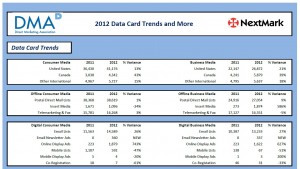
A recent Multichannel Merchant article presents an outlook for digital data to take center stage. While Washington continues to go back to the drawing board to draft new privacy legislation, experienced direct marketers continue to apply online and offline data for responsible direct marketing. For traditional list and data marketing professionals, this creates a need for a new kind of ‘rate card’ or data card for online display advertising. The opportunity to serve this market is open to everyone, and traditional direct marketing services providers have the experience backed with analytical expertise to make a difference.

Data cards are not only available on NextMark, but also on most list management web sites (many of which are hosted via the MarketMax Pro solution). An examples of these are the Parcel Magazine Mailing List and Developerfusion from World Innovators, and Pet Industry TotalBase from List Solutions.

“This online media is no longer new, and should be viewed as an extension of the services that traditional list brokers and managers represent and recommend to their clients,” says Lee Kroll, President, Kroll Direct Marketing.

You can download a free copy of the “2012 Data Card Trends Report” to see how the landscape is changing on our platforms.

Data Card Trends Report 2012

RFP event in Times Square draws a crowd

Wednesday, January 18th, 2012

It was standing room only last night as 180+ digital media pros packed the Manhattan room of the Marriott Marquis overlooking Times Square. Only expecting 140-150, they had to bring in extra chairs to handle the overflow.

Who would have guessed that the mundane topic of RFPs would draw such a crowd on a Tuesday night in January?  The RFP is certainly a hot topic (or sore subject?) among those in the digital media business. (more…)

Why the RFP fails in digital media buying

Wednesday, January 18th, 2012

As a follow up to the 9 ways the RFP fails in digital media buying, this article shows how today’s digital media landscape has rendered the RFP obsolete. (more…)