Blog

Visit NextMark at DMA 2012 on October 14-16 in Las Vegas

Tuesday, October 9th, 2012

The Direct Marketing Association is holding its big annual conference at the Mandalay Bay Resort in Las Vegas on October 14-16. The theme for this year’s event is “The Global Event for Real-Time Marketers.”

The DMA has come a long way since its beginnings as the “Direct Mail Marketing Association” many years ago. The focus has shifted from offline to digital marketing channels. While many of the basic principles of direct marketing still hold true, new digital channels are each unique and yet to be fully utilized. The DMA and this conference are leading the discussion on successes, failures, and emerging best practices.

NextMark will be among hundreds of exhibitors and sponsors at DMA 2012. We’ll be showing off our new solutions for digital media planning and digital ad sales.  Please visit us at our booth #920 to discover the latest trends and tools in digital media.

John Henry vs. Programmatic Buying

Wednesday, September 19th, 2012

Two articles published this week have caught my attention despite my recently self-imposed “information diet.” They rise above the din because of the keen observations they make on the changing workforce at advertising agencies.

“There’s a lot of inexperienced people on the ground doing a lot of grunt work.” – Forrester analyst Joanna O’Connell in Agencies in the Age of Machines by Brian Morrissey

“Accepting that there will be fewer and fewer staffers at the agency doing the grunt work of RFPs and spreadsheets: Do you really see more than a tiny handful of those people being retrained and redirected into right-brain Marketecture jobs?” – Upstream Group founder and CEO Doug Weaver in Brave New Agency

The disruptive force here is the rise of automated, programmatic buying machines. These machines eliminate manual human toil and efficiently grind towards their narrow objectives.

These articles remind me of the legend of John Henry vs. the steam-powered hammer.  In this folk tale, the status quo of hard manual labor is disrupted by a new technology: the steam-powered hammer. The laborers’ hero, John Henry, challenges the machine to a race. Through super-human strength and determination, John Henry wins the race. However, he dies at the finish line from over-exertion.

Is the digital media workforce composed of modern day John Henry’s? Will we suffer the fate of John Henry and die in our race against the machine? That’s one possible future.

Or can we adapt from laborer to knowledge worker? For this, we have to move from driving spikes to driving strategy. We have to move beyond today’s sledgehammer – Microsoft Excel – to tools that free our time and our brains to focus on higher-value pursuits. We have to train our right brain. Unfortunately, many won’t make the transition and will become obsolete. But those who adapt will survive and thrive.

Visit NextMark at IAB MIXX Oct 1-2 in NYC

Friday, September 14th, 2012

Please come visit the NextMark team at the IAB MIXX conference on October 1-2 in New York City. We’re really excited to be part of this conference – it’s *the* cornerstone digital advertising event of Advertising Week 2012. The IAB has put together a phenomenal agenda: the art and science of digital creativity, the ramifications of viewable impression metrics, Dennis Crowley of Foursquare, Neal Mohan of Google, Microsoft, Sheryl Sandberg of Facebook, AOL, Mastercard, Twitter, Tumblr, elections, Charlie Rose, Marc Andreesen, and more. Wow!

You can visit us and the other vendors for free with “expo only” passes. You’ll find us in the exhibit hall at booth #103. But when you see the agenda, you’ll probably want to go “all in” with the full conference pass.  Check it out here: http://www.iab.net/mixx


Need a replacement for Google’s DoubleClick Ad Planner?

Monday, August 27th, 2012

Google has just announced it will discontinue a number of features of its DoubleClick Ad Planner on September 5, 2012. Among the changes, Google is dropping “domains or ad placements that are not part of the Google Display Network (GDN).”

Some are unhappy with these changes because they’ll no longer be able to use the tool for direct sold premium placements. These placements are outside the GDN and still comprise the majority of online display media spending today.

That’s the bad news. The good news is there are alternatives to help you through the transition.

For non-GDN site and placement information, you can use the IAB Digital Advertising Directory. It’s a free tool with virtually all the top sites indexed found here: http://directory.iab.net/ You can also use free tools from Alexa, Compete, and Quantcast for site discovery.

As an alternative to Ad Planner’s phased out “Publisher Center,” publishers can create and maintain their own listings in the directory with NextMark’s Data Card Publisher – also a free tool found here: http://nextmark.com/media-sales/publisher/

Finally, if you need a new way to create media plans, you can use NextMark’s new Digital Media Planner. It’s a low cost and easy-to-use alternative for non-GDN sites and placements. It’s currently in private beta, but you can get free access here: http://nextmark.com/dmp

Where’s the innovation in guaranteed ad sales?

Thursday, August 9th, 2012

In “How publishers sell ad inventory,” Eric Picard of Rare Crowds gives a great overview of how guaranteed ad inventory is bought and sold. In his conclusion, he makes an excellent point:

“For all the innovation in the ad-tech space over the last decade, it’s fairly impressive that very few of the core problems of a publisher have been solved. At the end of the day, 60-80 percent of the revenue that publishers bring in comes from their premium inventory, sold on a guaranteed basis — which represents generally less than half of all their available inventory. Nearly all the ad technology innovation in the last decade has focused on what to do with that other half in order to raise the median price of that revenue from nearly zero to a bit more than zero.”

It makes no sense that the big piece of the pie has been neglected by technologists. They’ve been focused on algorithms and transactions to maximize the value of remnant inventory. How about match-making and workflow to maximize the value of premium inventory?

Technology for buying and selling premium is a big opportunity. This is a hot space for innovation.

Building the Core of Your Agency

Tuesday, July 31st, 2012

This article was previously published in The Makegood.

Advertising agencies are notoriously inefficient in digital media. A recent study showed that agencies typically spend more than $4,000 in media labor to place an advertisement on a website.

The good news for challengers is there’s a big opportunity to win business away from inefficient agencies by adopting new methods that give you a sustainable competitive advantage. Gaining this advantage starts by understanding your core competencies.

Here’s a handy litmus test: of everything you do at your agency, which of those activities does your client appreciate when you do a great job? Those are your core competencies. Conversely, which activities aren’t noticed even when you do a perfect job? Those are non-core activities.

Core competencies are the defining activities of your agency. A core competency fulfills three key criteria:

1. It differentiates you from your competitors.

2. It’s not easy for your competitors to copy.

3. It’s highly valued by your clients.

Identifying your core competencies is an important exercise because it guides your decisions on how to best allocate your resources. Once you understand your core, you know where to focus your time and money. You also discover where your resources are being squandered because they are diverted away from your core competencies.

To illustrate this concept, see figure 1 for a breakdown of core versus non-core activities of a media agency on a typical digital campaign.
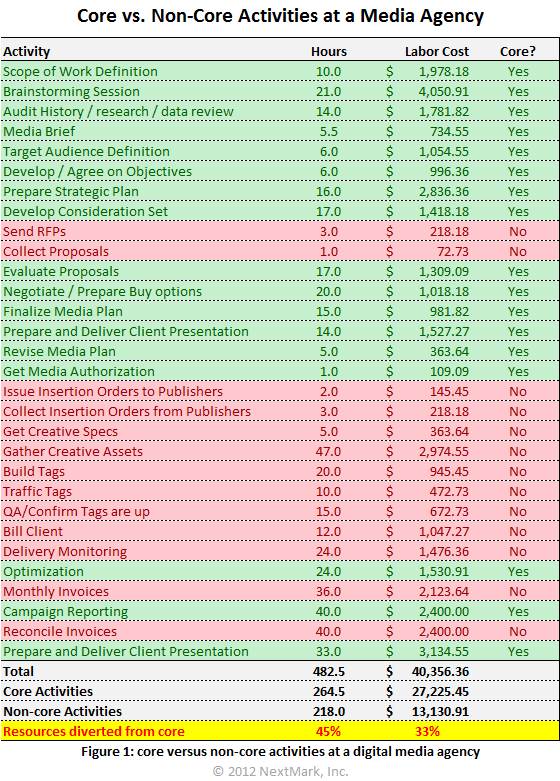
core vs non-core activities at a media agency

In this example, you see that 45% of time and 33% of labor costs are being diverted away from core competencies.

Non-core does not mean not important. For example, it’s critical to traffic tags without error. If not, the campaign would fail and your client would surely be disappointed with you.

How can you perform those non-core activities as efficiently as possible? The goal is to minimize the resources you spend on non-core activities. Cost advantage is a classic competitive advantage and even more powerful in the context of non-core activities.

Outsourcing is one way to reduce non-core activities. In addition to reducing costs, outsourcing insulates your organization from distractions related to running the operation like hiring, training, managing, providing office space, and many others. Outsourcing is common in many industries. For example, consider software companies and their data centers. Despite the mission-critical nature of the data center, the activities involved in running a data center are not a core competency of a software company. Therefore, it’s typical for a software company to outsource their data center to third party specialists. This enables the software company to focus their resources on their core competencies such as building software, selling software, and servicing their clients.

While it’s common for publishers to outsource their ad operations, it’s not yet common for agencies to outsource ad operations. The dynamic nature of agency ad operations makes it difficult to outsource. It’s not a factory job. Working in agency ad ops is like playing in a jazz band. You constantly have to adapt to changes from other “band” members. For example, revisions to creative assets often come without notice to meet client demands. These changes need to be implemented flawlessly without delay and to make beautiful “music” for your client.

“I’d outsource if I could,” says Michelle Burnham of Burnham Marketing. “I tried outsourcing our trafficking and reporting functions. It worked great when there weren’t any changes to the plan. Unfortunately, that’s hardly ever the case in digital. I found myself spending more time documenting what had to change than it would take me to make the changes myself. It was scary when we started running up against deadlines because of the short lead time on these changes. Ultimately, I gave up and brought it back in-house.”

While the benefits of outsourcing non-core activities are clear, it’s also clear that the problems related change management need to be resolved to make it feasible. Agencies that solve this problem will be able to focus their resources on high value activities and to operate more profitably.

Can you outsource your non-core activities? If not, why not? Answering these questions will help you discover weaknesses and opportunities in your agency.

Regardless whether or not you choose to outsource, your strength is at your core. Focus your time and money on your core competencies and you will gain a competitive advantage.

Media Magnet v2.1 gives you Goldilocks and Training Wheels modes

Friday, July 27th, 2012

Media Magnet has been winning praise among digital media veterans because it offers a fresh alternative to the much-maligned RFP process. It just got even better with version 2.1.

Early this morning, our superstar development team rolled out another set of improvements to Media Magnet. Altogether, version 2.1 includes 14 improvements that make it even easier to use.

Goldilocks Mode

As we’ve reviewed these new features, the one customers like the most is the counts in the category selector. It’s a simple but powerful tool. As you see in the screenshot above, each category now displays how many media programs are in the given category. This is helpful in creating a consideration set that’s not too big, not too small, but just right. Goldilocks would love this!

For example, in the Arts & Entertainment category, there are 1,389 media programs… that’s a big category! Maybe it would be a better strategy to pick a sub-category like Humor that only has 51 media programs to refine your consideration set. It all depends on what you and your client need.  The nice thing about this feature is it gives you more insight as you are creating your campaign. So, you can make more informed decisions.

Training Wheels Mode

We’ve also introduced a new “training wheels” mode (that’s what I call it). Previously, when you posted a new campaign it would instantly go live. That’s super-efficient, but sometimes it makes sense to have a review before releasing it. That’s what this new feature is all about. Now, when you post a new campaign we’ll review it with you before it goes out.
With this feature, you don’t have to worry about an embarrassing misfire. It also makes it easier to kick the tires without going live with a campaign.

More to come

We hope you like the new features. Please let us know how we can make it even better!

In Digital Advertising, Time is Money

Friday, July 6th, 2012

This article was originally published in The Makegood.

“I remember to have heard of a notable Woman, who was thoroughly sensible of the intrinsick Value of Time: Her Husband was a Shoe-maker, and an excellent Crafts-man; but never minded how the Minutes passed. In vain did his Wife inculcate to him, That Time is Money: He had too much Wit to apprehend her; and he cursed the Parish-Clock, every Night; which at last brought him to his Ruin;”
Ambrose Philips, 1719

With all the advanced technology in digital advertising today, you would think that placing an advertisement on a website would be as easy as clicking a button. Not so. In fact, the current reality is quite the opposite. It’s amazing how laborious, tedious, and expensive it is.

Brian Morrissey wrote about this problem in “Beefing up Banner Ads”:

“The dirty secret of Web advertising is the actual process of buying and selling ads isn’t very efficient. Compared to the TV industry, where a few dozen players can move billions of dollars, the legwork it takes to execute a Web ad campaign is laughable. According to ThinkEquity, administrative processes eat up 28 percent of the costs in Web advertising versus 2 percent in TV.”

That 28% online versus 2% TV overhead statistic has been used in presentations by Google and countless others to put a spotlight on the inefficiency in the process of placing an advertisement online (and to justify big investments in new technology). It’s a statistic that may have launched a thousand startups.

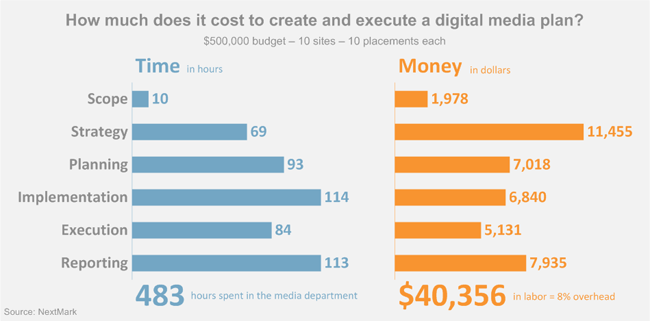
We recently took this research in a different direction with a study that asked the question “how much does it cost an agency to create and execute a digital media plan?” By using Activity-Based Costing and understanding all the tasks, roles, time, and hourly costs involved with the process, we calculated that it takes an agency 482.5 hours and costs an agency $40,356.36 in labor costs to spend $500,000 assuming 10 sites with 10 placements each. In other words, on average it takes 48.25 hours and costs $4,035 to place an ad on a website.

That’s a lot of time and money.

digital media time and money

The research showed 8% overhead expense in the agency’s media department (note: this number does not include creative and other expenses outside of agency media labor). This seemed high. However, in discussing this research with agency media executives, we learned that 8% is actually on the low side of the spectrum and that that 10-12% is a typical rule of thumb for digital media.

Online advertising is often sold on accountability. This accountability comes at a price. We found that 64% of the time spent on an online campaign is spent in implementation, execution, and reporting. Much of this time is spent manually copying and pasting data from one system to another because of lack of tools and integration. Microsoft Excel is still the tool of choice to fill the gaps and to tie it all together. TV does not have the extra burden of accountability at this level of detail (although that may change as TV becomes addressable).

This high cost situation is ripe for disruption. Cost advantage is a classic, powerful competitive advantage. Conversely, cost disadvantage is a classic weakness.

Agencies that employ inefficient manual processes and pass those costs along to their advertiser clients are in a risky position.

Procurement officers who look at this situation see an opportunity to squeeze out the inefficiency.

Entrepreneurs who look at this situation see a big opportunity. It only takes a quick glance at Terry Kawaja’s Lumascape to be overwhelmed by the innovation in advertising technology. To date, this innovation has been largely directed at remnant inventory, which is a small portion of the spending in digital advertising. However, direct sold inventory is next.

Agencies have a window of opportunity to take control of the situation and to gain a competitive advantage. Streamlining agency operations through workflow automation is the key and will be the subject of future articles in this column.

How agencies are punished for efficiency 91% of the time

Tuesday, May 29th, 2012

The inefficiency of digital media buying is well-known. Tools and methods to improve workflow and efficiency have been developed over the years, but they’ve not been widely adopted. Could it be that agencies aren’t properly rewarded for being efficient? Or, worse yet, could it be that agencies are actually punished for being more efficient?

Let’s take a look at the economics of efficiency at an advertising agency.

Starting around 1990, agencies have moved from media commission models to hourly (or “cost plus”) pricing models. This movement has been accelerated by shift of advertising spending to relatively inefficient digital advertising. According to the 4A’s Labor Billing Survey Report, 91% of proposals today are priced based on hourly rates (despite scoring lowest among alternatives on the Grossman Grid).

Imagine a new technology has been just been developed that doubles staff productivity through automation. In other words, this automation would enable you get the same amount of work done at the same level of quality with half the number of people. Furthermore, this technology costs only 5% of the value created. In other words, it would only cost $5,000 for every $100,000 saved.

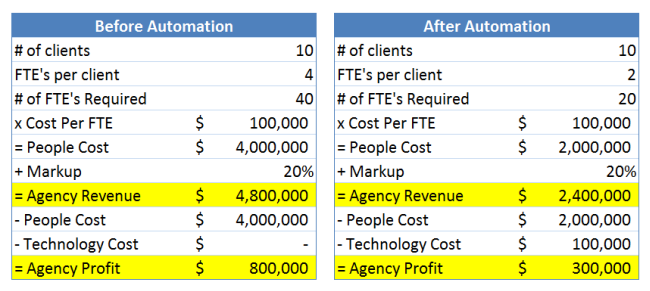
Purchasing and installing this new technology would normally be a “no brainer” decision. However, for the typical agency using hourly rates (or “cost-plus”) it’s not so simple. Consider the following before and after comparison:

agency economics before and after automation

As you see, the technology would enable the agency to serve the same 10 clients with half the number of people. It would reduce personnel costs by 50% saving the agency $2,000,000 per year while costing only $100,000 per year. That’s fantastic ROI on this new technology!

How would the agency be rewarded for this breakthrough? Since this agency uses hourly billing, there is no reward. In fact, there’s a huge punishment: the agency’s revenue would get cut in half, there would be a painful round of layoffs, and (assuming the agency can’t pass through the cost of productivity technology) the agency would suffer a 65.5% decline in profits. Not cool.

If you were making the decision, would you advocate this technology be purchased and installed? Given these numbers, that would be risky. Doing so would be what I call a CLM – a “career limiting move.”

The best argument to install this technology would be to gain a competitive advantage to win new business. But that would be a big bet. You’d have to more than double your business to make up for lost profits with existing clients.

Or you could change your compensation model to a value-based model, which would be a difficult transition. Would that be worth the risk?

This over-simplified example makes the point: digital media buying wants to be inefficient because of hourly compensation models. Until compensation move away from time-based models, there’s not much motivation to be more efficient.

Now available: an “air traffic control” system for managing digital media RFPs and proposals

Friday, May 18th, 2012

Media Magnet version 2.0 is now available. This upgrade introduces an “air traffic control” system for media planners at digital agencies who want to easily manage all their digital media RFP’s, RFC‘s, and proposals in one place. The improvements include:

1) Alerts and Invitations – This new section gives you 20/20 visibility into who has received alerts and invitations.
2) Contact list – For each alert sent, now you can see who got it.
3) Program list – For each publisher, now you can see a list of their properties that match your criteria.
4) Block button – Now you can block a publisher from submitting a proposal. This is handy in cases where you are already dealing with them in some other way or just don’t want to get a proposal.
5) Unblock button – If you change your mind about someone you’ve blocked, you can easily unblock to allow proposals
6) Invite others – This new button enables you invite others to submit proposals for your media plans. It’s effectively an RFP but a lot easier.
7) Status – Now you can see the status of every alert and invitation you’ve sent.  You can see if your RFPs have been viewed or responded to

Here’s a sample screen shot showing these new features:

To get you free Media Magnet account, go to http://nextmark.com/media-planning/media-magnet/.