Blog

A Publisher’s History of Programmatic Premium

Tuesday, April 2nd, 2013

Evolution

This article originally appeared on in AdExchanger.

It’s hard to argue that the banner ad era has been good to publishers. After a brief initial period in which banner inventory matched audience availability, publishers enjoyed double-digit CPMs and advertisers enjoyed unique access to a valuable audience of online “early adopters.” Prognosticators heralded a new golden era of publishing, and predicted the eventual death of print. Fifteen years later, print is barely breathing, but publishers are still awaiting a “golden era” where the promise of online media matches its potential. What happened on the long road of publisher monetization, and how did we arrive in this new “programmatic” era?

It didn’t take long after HotWired sold the first banner ad to AT&T for other online properties to start making banner ads part of every page they put onto the Web. Not immune to Adam Smith’s economic theory, banner CPMs lowered as impression availability rose. Suddenly, publishers were in the single digits for their “ROS” inventory, and had plenty of impressions left over every month. Smart technology companies like Tacoda saw an opportunity to aggregate this unsold inventory, and sell it based on behavioral and contextual signals they could collect. Thus, the Network Era was born. Because networks understood publishers’ audiences better than the publishers did, they were able to sell ads at a $5 CPM and keep $4 of it. That was a great business for a very long time, but is now coming to an end.

While not creating tremendous value for publishers, the Network Era did manage to pave the way for real time bidding, and the start of the Programmatic Era. Hundreds of millions of cookies, combined with a wealth of third-party data on individuals, presented a truly unique opportunity to separate audiences from the sites the visited, and enable marketers to buy one impression at a time. This was great for companies like Right Media, who aggregated these cookies into giant exchanges. For advertisers, being able to find the “auto intender” in the 5 trillion-impression haystack of the Web meant new performance and efficiency. For publishers, this was another way to further segregate audience from the valuable content they created. The DSP Era ensured that only the inventory that was hardest to monetize found its way into popular exchanges. Publishers ran up to a dozen tags at a time, and let SSPs decide which bids to accept. Average CPMs plunged.

Over the last several years, it seems like publishers — at least those with enough truly premium inventory — are fighting back. Sellers have brought programmatic efficiencies in two ways: implementing DMP technology to manage their real programmatic (RTB) channel; and leveraging programmatic direct (sometimes call “programmatic premium”) technologies to bring efficiencies to the way they hand-sell their guaranteed inventory. Let’s look at both:

  • Programmatic/RTB: Leveraging today’s DMP technology means not having to rely on third-parties to identify and segment audiences. Publishers have been trying to take more control of their audiences from day one. The smartest networks (Turn, Lotame) saw this happening years ago and opened up their capabilities to publishers, giving them the power and control to sell their own audiences. With the ability to segment and expand audiences, along with new analytics capabilities, publishers were able to capture back the lion’s share of revenue, previously lost to Kawaja-map companies via disintermediation.
  • Programmatic Direct: Although 80% of the conversation in publisher monetization has revolved around the type of data-driven audience buying furnished by LUMAscape companies, 80% of the display advertising spending has been happening in a very non-real-time way. Despite building enough tech to RTB-enable the globe, most publishers are selling their premium inventory one RFP at a time, and doing it with Microsoft Excel spreadsheets, PowerPoints, PDFs, and even fax machines. RTB companies are trying to pivot their technology to help publishers bring efficiency to selling premium inventory through private exchanges. Other supply-side companies (like iSocket, ShinyAds, and AdSlot) are giving publishers the tools to sell their premium ads (at premium prices) without bidding—and without an insertion order. On the demand side, companies like Centro, Facilitate, MediaOcean, and NextMark (disclosure: I work there) are trying to build systems that make planning and buying more systematic, and less manual.

As programmatic technology gains broader acceptance among publishers, they will find that they have turned the monetization wheel 180 degrees back in their favor. DMP technology will enable them to segment their audiences for targeting and lookalike modeling on their own sites, as well as manage audience extension programs for their clients via exchanges. They will, in effect, crate a balanced RTB playing field where DSPs and agency trading desks have a lot less pricing control. Programmatic Direct (or, more correctly, “systematic reserved”) technologies will help them expose their premium inventory to selected demand side customers at pre-negotiated prices, and execute deals at scale.

The Programmatic Era for publishers is about bringing power and control back into the hands of inventory owners, where it has always belonged. This will be good for publishers, who will do less to devalue their inventory, as well as advertisers, who will be able to access both channels of publisher inventory with greater efficiency and pricing transparency.

New Tech Takes On Cost-Plus Pricing by Agencies

Tuesday, March 26th, 2013

compensation

This article was originally published on the CMO site.

How the enterprise pays its ad agency actually matters. Here’s why.

I have been working for a company that makes software solutions for buying digital media, and I have worked for a number of ad technology companies in the past. In a world where digital banner ads are still purchased through email and fax, and media plans are mostly created using Microsoft Excel — technology dating from 1985 — the ad technology industry sees an opportunity to create efficiencies in the way media is bought and sold.

One of the odd industry dynamics we have encountered in bringing our product to market is how independent agencies are more apt to embrace new efficiencies than some of the “big four” owned agencies that lead the space in terms of media spend.

Logically, you’d think that gigantic media agencies, managing hundreds of media planners and buying on thousands on digital media channels, would grasp at the chance to do more planning with fewer personnel, migrating towards web-based tools that offer efficiency and centralization. The evidence has shown otherwise.

On the surface, it may seem as though the biggest difference between independent agencies and the majors is size. The majors have Ford, and the independents have the Ford dealers. They both work very hard to identify digital audiences, perform against marketers’ aggressive KPI goals, while trying to understand how they got there through detailed analytics. At the core, the difference between what media teams within holding company shops and a smaller agency does is minimal. So what accounts for the reluctance of bigger shops to innovate with technology tools?

One reason may be the way they get paid.

The biggest shops consistently rely upon cost-plus pricing, which pays them based on hours worked, plus an additional, negotiated margin. The typical $500,000 digital media plan takes an alarming 42 steps and nearly 500 man hours to complete, which can cost up to $50,000 — and that doesn’t even include developing the creative.

If you are paying your agency on a cost-plus basis, your agency doesn’t have a lot of incentive to create your plan faster, or with less labor. In fact, this type of pricing scheme creates an incentive for inefficiency, or what economists call a “perverse incentive.” Unfortunately, every cent you pay towards the labor of creating a media plan subtracts from the amount that can be dedicated to the media itself.

Spend

So, what to do? The most obvious choice for those working with a large agency under such a scheme is to try and change the payment terms. Pay-for-performance is optimal, but a careful analysis may show that paying on a percentage-of-spend model yields more reach, when you are not paying for the labor of building a media plan.

Some marketers are choosing instead to build small, efficient in-house teams to leverage the demand-side technologies that their agencies want to discover and buy digital media. Other marketers choose to work with multiple smaller, independent agencies that have specific expertise in different digital verticals. Those shops usually offer flexible fee structures, and you are far more likely to work with the team that pitched you after you hire them.

As they say in finance, it isn’t what you make, it’s what you keep. In digital media, moving away from cost-plus pricing relationships and towards new technologies for media buying means keeping more of your money for reach, and spending less on labor that doesn’t help you move the sales needle.

What We Love, Hate and Desire in Our Digital Media Jobs

Wednesday, March 20th, 2013

This presentation was given by Joe Pych at Digiday Agency Summit March 20, 2013 in Scottsdale, AZ. Two thirds of people in digital media plan to change jobs in the next two years because they are unhappy. This survey reveals the source of unhappiness and makes recommendations to increase job satisfaction.

To get a more detailed look at the findings, download the DAS SOTI March 2013 Happiness White Paper.

Shameless self-promotion: Among many other things, this survey revealed that 76.1% of agencies use Microsoft Excel to create their media plans.  It also revealed that 59.4% are not happy with their tools.  Are you unhappy with wasting your life away in Excel? You should try NextMark’s Digital Media Planner tool. It’s free and better than Excel in at least 31 ways.

Media Planning in Excel is a Fool’s Errand

Wednesday, March 6th, 2013

Yesterday, in a call with an agency president she said, “media planning in Excel is a fool’s errand.” This got me thinking about all the ways a purpose-built media planning tool like NextMark’s Digital Media Planner system gives a media planner a competitive advantage over those still using Microsoft Excel.

Here’s the list of the advantages (I’m sure I missed a few!):

Advantage Microsoft
Excel
NextMark
Planner
Year built 1985 2013
Create your media plan YES YES
Purpose-built for digital media planning no YES
Built-in media-specific calculations no YES
Easy one-screen interface YES YES
Modern user interface no YES
Media planning dashboard no YES
Clone previous media plans YES YES
Clone rows in a media plan YES YES
Easily import Research from comScore and other tools no YES
Find media programs with search tool no YES
Save time with type-ahead no YES
Get media ideas via suggestion tool no YES
Supports IAB standards no YES
Perform what-if analysis no YES
Link to Publisher data including placements, rates, inventory, and sales contact no YES
Link to comScore data including audience trends, profiles, and cross-visiting no YES
Send Requests for Proposals (RFPs) no YES
Track RFP status online no YES
Receive and manage proposals online no YES
Receive Requests for Consideration (RFCs) no YES
Accept proposals into your plan with a button click no YES
Share your media plan online no YES
Lock your plan while you are working on it no YES
View a full history of changes to your plan no YES
Compare to a prior versions of your plan no YES
Revert to a prior version of your plan no YES
Export Media Authorization no YES
Export Insertion Orders no YES
Export to Google DFA and other ad servers no YES
Integrate with other media tools via APIs no YES
Streamline your media planning process no YES
Get better insights no YES
Position yourself for the future no YES
Price $109.99 FREE

Learn more about NextMark Planner at www.NextMark.com/planner

Collaborate without fear with NextMark’s Digital Media Planner

Friday, February 22nd, 2013

nextmark-v1-3-versioning

NextMark today unveiled advanced collaboration features in its Digital Media Planner system. With this upgrade, digital media planners can collaboratively develop digital media plans without fear of losing their work, which is common using today’s solutions.

More than 80% of digital media agencies still use Microsoft Excel to produce their digital media plans. While flexible and easy to use, Excel has a long list of weaknesses that contribute to the high cost to create and execute a digital media plan. Some of Excel’s biggest weaknesses are it’s lack of support for collaboration and version control, which causes lost productivity.

Excel spreadsheets are stored in a file format. As such, only the latest actively saved version is available.  If you forget to save your changes or your machine crashes, your work is lost.  If you and a co-worker unknowingly work on the same Excel media plan at the same time, your work will be lost if he saves his changes after you save yours.  Or you will clobber his work if you save changes work after his. Either way, valuable work is lost. The problem gets worse when you use email to share your Excel media plan because having many files in different places compounds the problem. Good luck trying to merge changes from two or more Excel files; this tedious task takes forever and you’re almost guaranteed to lose some of the work.

Even if you somehow manage to avoid all the file versioning landmines, it’s practically impossible to keep track of all the changes made during the planning process.  When your client asks you “how did this line get into the plan?” you won’t find the answer in Excel.

NextMark’s new Digital Media Planner (v1.3) solves these problems. With Planner, you get the flexibility and usability of a spreadsheet plus a powerful collaboration system. That’s because with Planner your work is always saved securely in cloud database storage with built in collaboration controls:

  1. When you start working on a media plan, you get a lock on the plan so nobody else clobbers your work.
  2. If your co-worker tries to work on same plan at the same time, he sees a warning that you are working on it and is prevented from making changes until you are done.
  3. Your changes are saved immediately as you make them. You don’t even have to hit a save button! (If you’ve ever used Google Docs, you know how handy this can be.)
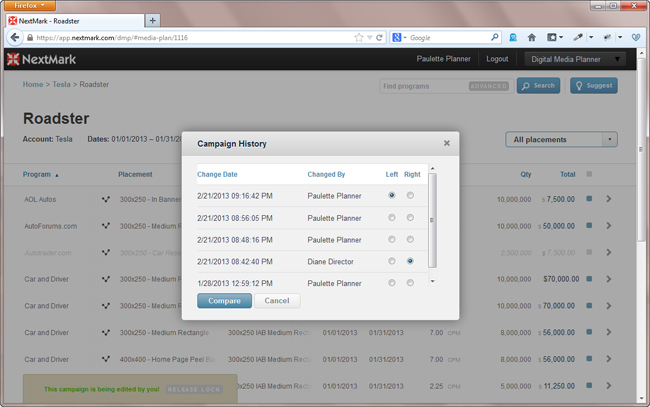
  4. You can see a complete history of changes to the media plan: when the changes were made and who made each change.
  5. You can easily compare two versions of your media plan and see all the changes highlighted.
  6. If you make a mistake on your plan, it’s easy to revert back to a prior version.

Basically, you’ll never ever again have to deal with a bunch of out-of-synch versions of your media plan. And you’ll never lose your work again.

If you work for an agency that deals with Sarbanes-Oxley compliance or just wants better management controls, the built-in audit trail and comparison features are a godsend.

And, despite all the power of these advanced features, Planner is super easy to use. Even easier than Excel!

Don’t you think it’s time to finally ditch Excel? Want to learn more about how NextMark’s Planner can help you? Request your free access here.

NextMark Opens New York City Office

Wednesday, February 20th, 2013

nextmark-nyc-office-door

NextMark, Inc., a marketing and advertising technology provider, today announced it has opened an office in New York City. The new office, located at 53 West 36th Street, will be managed by recently hired Chief Revenue Officer Chris O’Hara and will be used primarily for sales and service.

“More than ever, having a daily physical presence in New York is important to properly serving our clients,” said Joseph Pych, NextMark’s CEO. “About half of our worldwide client base is in New York and the surrounding metro area. Although we’ve served New York well over the past 12 years, it’s clear we have to ramp up in response to demand for our new products for digital advertising.”

Since its launch less than 3 months ago, more than 75 agencies have started using or are in the process of being set up on the NextMark’s new Digital Media Planner system.

Budgeting just got easier with NextMark Planner v1.2

Tuesday, January 29th, 2013

NextMark Planner Budget Overview

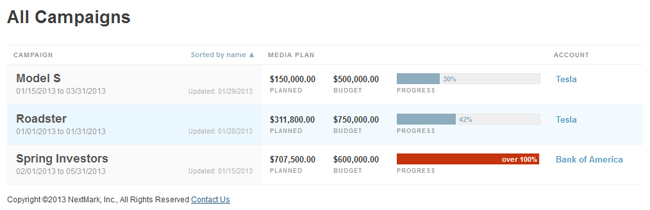
Tracking to client budgets can sometimes be a challenge in digital media planning. With the latest release of NextMark’s Digital Media Planner (version 1.2 released Friday, 1/25/13), you now have a handy visualization on your homepage that makes it easier for you to stay on budget on all your campaigns.

Want to get NextMark Planner? Request your free access here.


Digital media planning just got even easier

Wednesday, December 19th, 2012

Planner campaign start

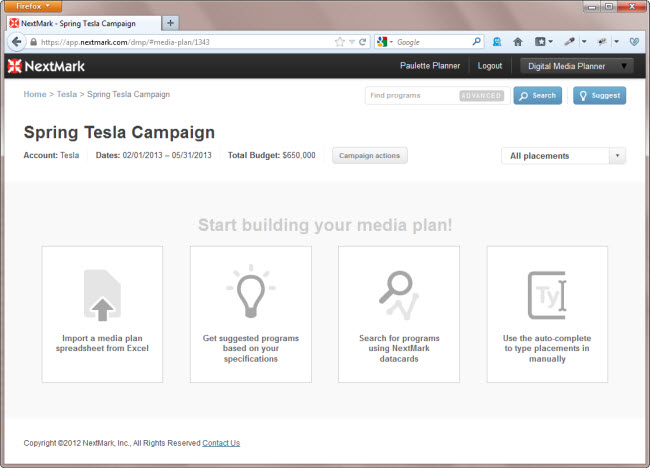
Less than three weeks ago, we introduced the new Digital Media Planner tool. It was built specifically to make digital media media planning easy. Today, we upgraded the software to make it even easier. Now when you create a new campaign, you are greeted with four easy options to get started: import a file, suggestion tool, search tool, or type-ahead. In every case, the system is making your life as a media planner easier.

Want to learn more about the tool? Go to http://www.NextMark.com/planner.

NextMark Aims to Replace Excel With New Digital Media Planner

Sunday, December 2nd, 2012

Scottsdale, AZ – December 2, 2012 – NextMark, Inc. today unveiled a new system for automating digital media planning workflow at advertising agencies at the iMedia Agency Summit conference in Scottsdale, Arizona. The new system is called Digital Media Planner.

According to NextMark’s research, it costs agencies more than $40,000 per campaign in labor costs to create and execute a digital media plan and executing a digital media plan involves a tedious 42-step process. One of the main reasons for the high cost is the use of Microsoft Excel and manual processes. It’s a process that’s ripe for automation. The promises of workflow automation are to save time, eliminate mistakes, reduce transaction costs, increase agency profitability, and increase employee morale.

However, purpose-built workflow automation systems have so far failed to gain widespread adoption among advertising agencies. A survey of 65 digital media executives at the conference revealed that 80% (52 of the 65) still use Microsoft Excel and manual processes to create media plans while only 20% use a workflow system.  The four main reasons for failed adoption of workflow system alternatives to Excel cited are: too cumbersome, too limited in functionality, too expensive, and not integrated.

NextMark is aiming to replace Excel in the digital media planning process with its new Digital Media Planner system. The Planner is designed for independent digital advertising agencies, but can be used by agencies of all types and sizes. The system is accessed through the web as cloud-based software running on an enterprise-class SAS-70, Sarbanes-Oxley compliant platform.

Joe Pych, CEO of NextMark, unveiled the Digital Media Planner system and demonstrated the its main features at the conference including: importing from comScore Key Measures output; accessing advertising program details such as placements, inventory, rates, and audience profile via its data cards; creating a media plan using an intuitive spreadsheet interface; and exporting to Google’s DFA Ad Server. Mr. Pych indicated the system is available for free.

“Our goal for is to make digital media planning easy,” said Mr. Pych. “It seems like fighting windmills, but it’s about time someone replaced Excel because it causes so many problems and widespread unhappiness among digital media planners.”

Initial reactions to the Planner among conference attendees were positive. “My media planners are going to hug me for bringing this back to them!,” said Melissa Hodgdon, Vice President, Media Director of Engauge.

More information about NextMark’s Digital Media Planner is available on NextMark’s website at http://www.NextMark.com/dmp.

Why is automation important to digital media directors?

Sunday, December 2nd, 2012

Here is the presentation I gave this morning to a packed room of 70 media executives at the iMedia Agency Summit at the Camelback Inn in Scottsdale, AZ (super nice place btw!):

I presented our research that shows it costs more than $40k to create and execute a digital media plan and that executing a digital media plan involves a 42-step process. This process seems so ripe for automation with the high cost and labor. However, the Media Planning Tools Survey show of hands survey overwhelmingly concluded that Excel is still the top choice among media pros (as I’ve previously blogged). No surprise there… thankfully, because the rest of my presentation depended on that!

Despite the volume of screen shot slides in the presentation, I did rapid-fire 8-minute flyover of our newest creation: the Digital Media Planner system. We just launched it two days ago. This is the first time I’ve shown it off in public. I thought the iMedia Agency Summit was the perfect venue for the reveal since it is designed specifically for media planners at independent agencies. We structured our development timeline to launch in time for the conference.As always, our fantastic development team hit their dates (we’re big on shipping on time).

Being the first public reveal of the Digital Media Planner, I was afraid nervous nobody would like it. But based on a show of hands survey, virtually everyone did like it. Yay! So, that gave my ego a big boost (although maybe they were just being nice to me because I bought them all breakfast).

Why is automation important?

The main part of the session was to ask the audience the question: “why is automation important?” in digital media planning. Hands went up and I heard lots of smart answers, including roughly in this order:

  1. “profitability – the faster we can get things done, the more business we can take on”
  2. “efficiency – faster workflow – automation makes it easy to make on-the-fly changes quickly”
  3. “streamlining the process”
  4. “minimizes risk and human error”
  5. “media planner happiness”

I was pleasantly surprised that “profitability” was the first answer within two milliseconds. Most think “efficiency” first and business growth comes after a few minutes.  Lack of automation is clearly holding back both the top and bottom line at digital agencies. I’m glad someone answered “happiness” because that’s what it’s all about IMHO (and because I littered the place with “happiness” mugs). You find happiness is the core value of automation when you repeatedly ask why. And that’s why we internally call the development of the Digital Media Planner system, the “Digital Media Planner Happiness Project.”

Besides the free food, everyone at the breakfast got a free limited-edition coffee mug, hand-crafted by me. I created the smiley face image by hand using one of my favorite apps on my iPad – Paper by FiftyThree. Below is a picture of the mug as the group was filing in. It says “digital media planner happiness project” on the other side just like on the title slide of the presentation. Let me know if you want one of these mugs – I made 200 and there will be some left over.

Now it’s time to get outside and enjoy the warm, sunny day here in Scottsdale. Speaking of happiness, I’m very happy they hold these conferences at such beautiful places!