Blog

Addressable media updates

NextMark's Blog

Recommendations, updates, and thoughts from the NextMark executive team.

We’re hiring: Senior Director of Agency Sales – New York City

May 20th, 2013

help-wantedBased on the early success the new Digital Media Planner tool, NextMark is ramping up its marketing and sales team in New York City. We’re seeking mid-level sales professionals with experience in selling technology to advertising agencies. This is a unique opportunity for you to get in on the ground floor of “programmatic direct” media buying with a new product that’s been validated in the marketplace at a company that’s already been profitable for 10 years selling media planning solutions on an enterprise-grade platform.

Learn more about the job: Senior Director of Agency Sales – New York City.

We’re hiring – Software QA Engineer – Hanover, NH

May 14th, 2013

help-wanted

Are you an experienced software quality assurance engineer looking for a new challenge? NextMark delivers state-of-the-art web-based solutions in the red-hot sector of advertising technology. Learn more about this job: Software QA Engineer Job – Hanover, NH.

Are Publisher Trading Desks Next?

May 14th, 2013

tradingDeskThis post originally appeared in AdExchanger.

A long time ago, I was selling highly premium banner ad inventory to major advertisers. Part of a larger media organization, our site had great consumer electronics content tailored to successful professional and amateur product enthusiasts. The thing we loved most was sponsorships and advertorials. We practically had a micro-agency inside our shop, and we produced amazing custom websites, contests, and branded content sections for our best clients. They loved our creative approach, subject matter expertise, and association with our amazing brand. They still capture this revenue today.

The next thing we loved was our homepage and index page banner inventory. We sold all of our premium inventory—mostly 728×90 and 300×250 banners—by hand, and realized very nice CPMs. Back then, we were getting CPMs upwards of $50, since we had an audience of high-spending B2B readers. I imagine that today, the same site is running lots of premium video and rich media, and getting CPMs in the high teens for their above-the fold inventory and pre-roll in their video player. I was on the site recently, and saw most of the same major advertisers running strong throughout the popular parts of the site. Today, a lot of this “transactional RFP” activity is being handled by programmatic direct technologies that include companies like NextMark, Centro, iSocket, and AdSlot, not to mention MediaOcean.

What about remnant? We really didn’t think about it much. Actually, realizing how worthless most of that below-the-fold and deep-paged inventory was, we ran house ads, or bundled lots of “value added ROS” impression together for our good customers. Those were simple days, when monetization was focused on having salespeople sell more—and pushing your editorial team to produce more content worthy of high CPM banner placements.

Come to think of it, it seems like not much has changed over the last 10 years, with the notable exception of publishers’ approach to remnant inventory. About five years ago, they found some ad tech folks to take 100% of it off their hands. Even though they didn’t get a lot of money for it, they figured it was okay, since they could focus on their premium inventory and sales relationships. In doing some of those early network deals, I wondered who the hell would want millions of below-the-fold banners and 468x90s, anyway? Boy, was I stupid. Close your eyes for a year or two, and a whole “Kawaja map” pops up.

Anyhow, we all know what happened next. Networks used data and technology to make the crap they were buying more relevant to advertisers (“audience targeting”), and the demand side—seeing CPMs drop from $17 to $7, played right along. Advertisers LOVE programmatic RTB buying. It puts them in the driver’s seat, lets them determine pricing, and also (thanks to “agency trading desks”) lets them enhance their shrinking margins with a media vigorish. Unfortunately, for publishers, it meant that a rising sea of audience targeting capability only lifted the agency and ad tech boats. Publishers were seeing CPMs decline, networks eat into overall ad spending, DSPs further devaluing inventory, and self-service platforms like Facebook siphon off more of the pie.

How do publishers get control back of their remnant inventory—and start to take their rightful ownership of audience targeting?

That has now become simple (well, it’s simple after some painful tech implementation). Data Management Platforms are the key for publishers looking to segment, target, and expand their audiences via lookalike modeling. They can leverage their clients’ first party data and their own to drive powerful audience-targeted campaigns right within their own domains, and start capturing real CPMs for their inventory rather than handing networks and SSPs the lion’s share of the advertising dollar. That is step number one, and any publisher with a significant amount of under-monetized inventory would be foolish to do otherwise. Why did Lotame switch from network to DMP years ago? Because they saw this coming. Now they help publishers power their own inventory and get back control. Understanding your audience—and having powerful insights to help your advertisers understand it—is the key to success. Right now, there are about a dozen DMPs that are highly effective for audience activation.

What is even more interesting to me is what a publisher can do after they start to understand audiences better. The really cool thing about DMPs is that they can enable a publisher to have their own type of “trading desk.” Before we go wild and start taking about “PTDs” or PTSDs or whatever, let me explain.

If I am BigSportsSite, for example, and I am the world’s foremost expert in sports content, ranking #1 or #2 in Comscore for my category, and consistently selling my inventory at a premium, what happens when I only have $800,000 in “basketball enthusiasts” in a month and my advertiser needs $1,000,000 worth? What happens today is that the agency buys up every last scrap of premium inventory he can find on my site and others, and then plunks the rest of her budget down on an agency trading desk, who uses MediaMath to find “basketball intenders” and other likely males across a wide range of exchange inventory.

But doesn’t BigSportsSite know more about this particular audience than anyone else? Aren’t they the ones with historical campaign data, access to tons of first-party site data, and access to their clients’ first party data as well? Aren’t they the ones with the content expertise which enables them to see what types of pages and context perform well for various types of creative? Also, doesn’t BigSportsSite license content to a larger network of pre-qualified, premium sites that also have access to a similar audience? If the answer to all of the above is yes, why doesn’t BigSportsSite run a trading desk, and do reach extension on their advertisers’ behalf?

I think the answer is that they haven’t had access to the right set of tools so far—and, more so, the notion of “audience discovery” has somehow been put in the hands of the demand side. I think that’s a huge mistake. If I’m a publisher who frequently runs out of category-specific inventory like “sports lovers,” I am immediately going to install a DMP and hire a very smart guy to help me when I can’t monetize the last $200,000 of an RFP. Advertisers trust BigSportsSite to be the authority in their audience, and (as importantly) the arbiter of what constitutes high quality category content.

Why let the demand side have all of the fun? Publishers who understand their audience can find them on their own site, their clients’ sites, across an affiliated network of partner sites, and in the long tail through exchanges. These multi-tiered audience packages can be delivered through one trusted partner, and aligned with their concurrent sponsorship and transactional premium direct advertising.

Maybe we shouldn’t call them Publisher Trading Desks, but every good publisher should have one.

“Air Traffic Control” for Media RFP Proposal Management

May 10th, 2013

NextMark Planner RFP Manager Visualization

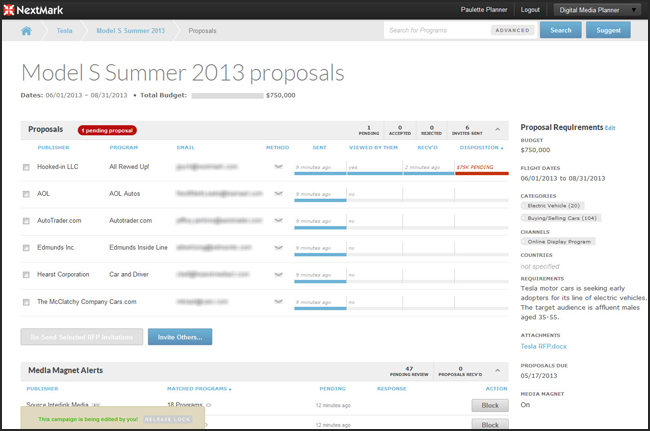
Last night, NextMark’s Digital Media Planning system was upgraded to give you a new tool for automatically keeping track of your Requests for Proposals (RFPs) and the proposals that come in response.

RFP management in digital advertising is well-known to be a frustrating mess. Despite recently celebrating the eighteenth anniversary of the banner ad, sending RFP requests and handling proposal responses is still a highly manual effort involving emails, Excel spreadsheets, shared file folders, phone calls, sticky notes, and plenty of manual labor. Despite its many failings and costing agencies more than $3,000 per campaign in labor, nobody has yet developed a widely adopted alternative to this time consuming and expensive process.

Fresh on the heels of version 2.0, NextMark Planner v2.1, released May 9, 2013, brings much needed automation to RFP management:

  • Send RFPs from your media plan – with contacts pre-filled for you (no more tracking down contact info)!
  • Automatically keeps track of who has viewed your RFP and who has responded with a proposal
  • Makes it easy to send reminders to those that have not responded
  • Automatically organizes all your proposals and documents (screen shots, media kits, etc.) all in one place
  • One-click access to proposal details
  • One-click accept or reject of proposals
  • Automatically tracks the status of every proposal – pending, accepted, or rejected
  • All this and more in a clean and super easy-to-use interface

This new set of features is now available to you if you’re using NextMark Planner. If you don’t yet have access, you can request it here: www.NextMark.com/planner.

2013 Will be the Year of Programmatic Direct

May 7th, 2013

guaranteed_stamp

A version of this post originally appeared in ClickZ.

Fairfax Cone, the founder of Foote, Cone, and Belding once famously remarked that the problem with the agency business was that “the inventory goes down the elevator at night.” He was talking about the people themselves. For digital media agencies, who rely on 23 year-old media planners to work long hours grinding on Excel spreadsheets and managing vendors, that might be a problem.

For all of the hype and investment behind real-time bidding, the fact is that “programmatically bought” media (RTB) will only account for roughly $2B of the anticipated $15B in digital display spending this year, or a little over 13% depending on who you believe. Even if that number were to double, the lion’s share of digital display still happens the old fashioned way: Publishers hand-sell premium guaranteed inventory to agencies.

Kawaja map companies, founded to apply data and technology to the problem of audience buying, have gotten the most ink, most venture funding, and most share of voice over the past 5 years. The amount of innovation and real technology that has been brought to bear on audience targeting and optimization has been huge, and highly valuable. Today, platforms like The Rubicon Project process over a trillion ad bids and over 100B ad transactions every month. Companies like AppNexus have paid down technology pipes that bring the power of extensible platform technology to large and small digital advertising businesses alike. And inventory? There are over 5 trillion impressions a month ready to be purchased, most of which sit in exchanges powered by just such technology.

All of that bring said, the market continues to put the majority of its money into premium guaranteed. They are, in effect, saying, “I know I can buy the ‘sports lovers’ segment through my DSP, and I will—but what I really want is to reach sports lovers where they love to go: ESPN.com.”

So, while RTB and related ad technologies will grow, they will not grow fast enough to support all of the many companies in the ecosystem that need a slice of 2013’s $2B RTB pie to survive. NextMark founder and CEO, Joseph Pych, whose company focuses on guaranteed reserved software, has been calling this the great “Sutton Pivot,” referring to the famous remark of criminal Willie Sutton , who robbed banks “because that’s where the money is.”

In order to better inderstand why this is happening, I have identified several problems with RTB that are driving companies focused on RTB to need to pivot:

  • There’s a Natural Cap on RTB Growth: I think today’s RTB technology is the best place to buy remnant inventory. As long as there are low-value impressions to buy, and as long as publishers continue to festoon their pages with IAB-standard banners, there will need to be a technology solution to navigate through the sea of available inventory, and apply data (and algorithms) to choose the right combination of inventory and creative to reach defined performance goals. While the impressions may grow, the real cap on RTB growth will be the most important KPI of them all: Share of time spent. Marketers spend money where people spend their time, whether it’s on television, Twitter, radio, or Facebook. When people spend less time on the inventory represented within exchanges, then the growth trend will reverse itself. (Already we are seeing a significant shift in budget allocation from “traditional” exchanges to FBX).
  • The Pool is Still Dirty: It goes without saying, but the biggest problem in terms of RTB growth is brand safety. The type of inventory available in exchanges that sells, on average, for less than a dollar is probably worth just that. When you buy an $850 suit from Joseph A. Bank—and receive two free suits, two shirts, and two ties—you feel good. But it doesn’t take much figuring to understand that you just bought 3 $200 suits, two $75 shirts, and two $50 ties. Can you get $15 CPM premium homepage inventory for $3 CPM? No…and you never will be able to, but that type of inventory is just what the world’s largest marketers want. They would also like URL-level transparency into where their ads appeared, a limit on the number of ads on a page (share of voice), and some assurance that their ads are being seen (viewability).  Inventory will continually grow, but good, premium inventory will grow more slowly.
  • It’s Not about Private Exchanges: Look, there’s nothing wrong with giving certain advertisers a “first look” at your premium inventory if you are a publisher.  Auto sites have been pursuing this concept forever. Big auto sites guarantee Ford, for example, all of the banner inventory associated with searches for Ford-branded vehicles over the course of a year. This ensures the marketer gets to his prospect when deep in the consideration set. Big auto sites may create programmatic functionality around enabling this type of transaction, but private exchange functionality isn’t going to be the savior of RTB, just necessary functionality. Big marketers want control of share of voice, placement, and flexibility in rates and programs that extend beyond the functionality currently available in DSPs. As long as they are spending the money, they will get—and demand—service.

What does all of this mean? RTB-enables ad technology is not going away, but some of the companies that require real time bidding to grow at breakneck speed to survive are going to pivot towards the money, developing technologies that enable more efficient buying of premium guaranteed inventory—where the other 85% of media budgets happen.  I predict that 2013 will be the year of “programmatic direct” which will be the label that people apply to any technology that enables agencies and marketers to access reserved inventory more efficiently. If we can apply some of the amazing technology we have built to making buying (and selling) great inventory easier, more efficient, and better performing, it will be an amazing year.

Programmatic Direct is not about Bidding

April 30th, 2013

bid-nobid-article

A version of this article riginally appearded in the EConsultancy blog.

“A market is never saturated with a good product, but it is quickly saturated with a bad one” – Henry Ford

When it comes to digital publishing sales, it seems like many publishers are questioning whether the product they have—the standard banner ad—is what they should be selling. Last month, I wrote that 2013 would be the year of programmatic direct, where LUMA map companies who make their living in real time bidding turn towards the guaranteed space, where 80% of digital marketing dollars are being spent. My recent experience at Digiday Exchange Summit convinced me that this meme continues—with an important distinction: programmatic direct (also described as “programmatic premium”) is not about bidding on  quality inventory through exchanges. Rather, it is about using technology to enable premium guaranteed buys at scale. Here is what I heard:

The Era of the Transactional RFP is Over

Forbes’ Meredith Levien currently gets 10% of her display revenue from programmatic buying, up from 2% in 2011. The rest of her revenue is comprised of 45% premium programs , and 45% from what she calls the “transactional RFP” business. The latter is the type that comes from continually responding to agency RFPs for standard IAB banner programs, with little customization. Levien questioned whether that type of transactional business was completely on its way to becoming driven exclusively by technology.

Are publishers really going to be able to abandon the  relentless RFP treadmill where countless hours are spent reacting to agency RFPs—many of which are sent to over 100 publishers, despite the fact that an average of 5 find themselves on the campaign? In order for that to happen, Levien said, the very language we are using must change. The language of the transactional RFP (“GRP,” “CPM,” “Impressions”) must change to the language of premium (“Social Shares,” “Influence,” and “Engagement”). Ultimately, Levien sees a world where there are fewer people managing  RFP response and more multi-disciplinary teams that create super premium tentpole programs for large brands. Forbes’ teams feature copywriters, developers, and creatives who don’t talk about the “buy details” of a campaign, but more about the social and cultural implications a great advertising program can create.

To paraphrase Federated’s CEO Deanna Brown, publishers “really have to question whether sending 100 e-mails to win a $50,000 RFP is worth it.”

Create Scarcity

Gannett’s Steve Ahlberg was even more forceful in his rejection of programmatic buying, and the transactional nature of guaranteed buying. After living in a world of their own creation (pages festooned Nascar-like with low-CPM banners) USAToday.com took the draconian move of removing all below-the-fold ads from its site, stripped every network and exchange tag from its pages, and decided to have one large ad placement per page. The experiment—revenue neutral in the 4th quarter of 2012—has thus far proven that publishers can get off “set it and forget it” SSP revenue by creating the type of scarcity that drives up both rates and demand. According to Ahlberg, the publication is talking to quality brand clients that were not on the radar just months before.

Part of the equation is getting away from standardized IAB units and trying to create a “television-like” experience for brand advertisers. Like Forbes, that means getting RFP response teams away from transactional duties, and leveraging cross-disciplinary teams that think like wealth managers, rather than salespeople. Instead of asking about reach and frequency, USAToday.com asks brands what they want to accomplish, and works with them to craft campaigns that work towards a different set of KPIs.

“If the Premium Publishers’ Product is the Banner Ad, then they are in Trouble”

For Walker Jacobs, who oversees Turner’s digital ad sales, the recent leaps and bounds in programmatic technology has done nothing but “accelerate the bifurcation of the ecosystem” which is divided been the good inventory and the bad. Like Gannett, Turner takes a jaundiced view of the programmatic ad economy.  “Our RTB strategy is ‘no’,” as Jacobs concisely put it.

Going further, Jacobs suggested that “there is no such thing as programmatic premium” in a world saturated with banner ad units, many of which go unseen. Standard banners, therefore, are a “flawed currency.”  It is hard to argue with Jacobs in a world that sees 5 trillion impressions every month.

It is clear that, despite the massive strides being made in programmatic buying technology, there is a very large gap between publishers who control super premium inventory, and those that do not. Publishers in the former want to find more streamlined and efficient ways to respond to RFPs, and ultimately turn more of their efforts into selling creative, multi-tiered, tentpole solutions to major brands. It doesn’t sound like many premium publishers are implementing private exchanges either, despite all of the hype in 2012. As Dan Mosher of Brightroll Exchange remarked, a private exchange “is just a blocklist feature of a larger platform.”

In 2013, it seems like premium publishers are not embracing private exchanges, not because of the technology, but rather because they are rejecting the notion of commoditization of their inventory in general.  For most premium publishers, there are the types of sales: Super-premium programs, that will continue to be handled primarily by their direct sales force; “transactional RFP” business for standard IAB display units, which most see being streamlined by “systemic” reserved platform technologies; and programmatic RTB sales of lower class inventory.

So, is 2013 the year of “programmatic direct?” Yes—but only if that means that publishers embrace technologies that help them streamline the way they hand-sell their top-tier inventory.


On the Road to Programmatic Direct

April 23rd, 2013

PremiumWin

A version of this post originally appeared in ClickZ .

As the bloated Display LUMAscape shifts, more and more companies focused on real time bidding are turning their venture-funded ships in the direction of programmatic direct and trying to pivot towards an area where nearly 80% of display media budgets are spent. This has been called the “Sutton Pivot,” referring to the notion of robbing banks, because “that’s where the money is.”

The fact that that 80%—over $6 billion—is largely transacted using e-mail, Microsoft Excel, and fax machines is staggering in a world in which Facebook is becoming passé. a lor of people have been calling the move to create efficiency in guaranteed display buying “programmatic premium,” but it’s not 100% about inventory quality.  The larger question is whether or not publishers are going to enable truly premium inventory to be purchased in a way that lessens their control. At a recent industry conference, publishers including Gannett and Turner completely rejected RTB and “programmatic” notions. In a world of ever growing inventory, the premium stuff is ever shrinking as a percentage—and that means scarcity, which is the publisher’s best friend. Selling less of a higher margin product is business 101.

As I wrote recently, at the same conference, Forbes’ Meredith Levien laid out the three principle chunks of inventory a super-premium publisher controls, and I want to examine the programmatic direct notion against each of these:

  • Super Premium: Big publishers love big “tent pole” branding campaigns, and are busy building mini-agencies within their sales groups, which bring together custom sponsorship packages that go beyond IAB standard banners. A big tent pole effort might involve a homepage takeover, custom rich media units, a dedicated video player, and branded social elements within a site. While some of the display elements within such a campaign can be purchased through a buying platform, this type of complex sale will never scale with technology, and is the very antithesis of “programmatic.” For many publishers, this type of sale may comprise up to 50% of their revenue. Today’s existing buying and selling platforms will be hard pressed to bring “programmatic” efficiencies here.
  • Transactional: Many super-premium (and most premium) publishers spend a lot of their time in the RFP mill, churning out 10 proposals and winning 2   or 3 of them. This “transactional RFP” business is begging for reform, and great companies like AdSlotiSocketOperative, and ShinyAds are starting to offer ways to make selling premium inventory such as this as programmatic as possible. Companies such as CentroFacilitateMediaOcean, and NextMark (disclosure: my company) are starting to offer ways to make discovering and buying premium inventory such as this as programmatic as possible. Much of the RFP process is driven by advertisers looking for information that doesn’t need to be offered by a human being: How much inventory do you have, when do you have it, and how much does it cost? This information is being increasingly found within platforms—which also enable, via tight pub-side ad server integrations, the ability to “buy it now.” 100% of this business will eventually happen programmatically. Whether or not today’s big RTB players can pivot their demand- and supply-side technologies to handle this distinct type of transaction (not very “real time” and not very “bidded”) remains to be seen.
  • Programmatic RTB: There will always be a place for programmatic buying in display—and there has to be, with the sheer amount of inventory available. Let’s face it: the reason the LUMAscape is so crowded is that it takes a LOT of technology to find the “premium” needle in a haystack that consists of over 5 trillion impressions per month. If the super-premium inventory publishers have to sell is spoken for, and the “transactional” premium inventory publishers sell is increasingly going to other (non-RTB) platforms, then it follows that there is very little “premium” inventory available to be bought in the programmatic channel.

The middle layer—deals that are currently being done via the RFP process, is where programmatic direct  is going to take place. In this type of buy, a demand-side platform will create efficiencies that eliminate the cutting and pasting of Excel and faxing and e-mailing of document-based orders, and a supply-side platform will help publishers expose their premium inventory to buyers with pricing and availability details. That sort of system sounds more like a “systematic guaranteed” platform for premium inventory.


RFP and proposal management just got easier with Planner 2.0

April 18th, 2013

Proposal-Manager-Screen-Shot

NextMark today announced an upgrade to its digital media planning software, which adds key functionality for handling RFPs and media proposals.

The Request for Proposal or RFP process in digital advertising is well-known to be a frustrating mess. Despite recently celebrating the eighteenth anniversary of the banner ad, sending RFP requests and handling proposal responses is still a highly manual effort involving emails, Excel spreadsheets, shared file folders, phone calls, sticky notes, and plenty of manual labor. Despite its many failings and costing agencies more than $3,000 per campaign in labor, nobody has yet developed a widely adopted alternative to this time consuming and expensive process.

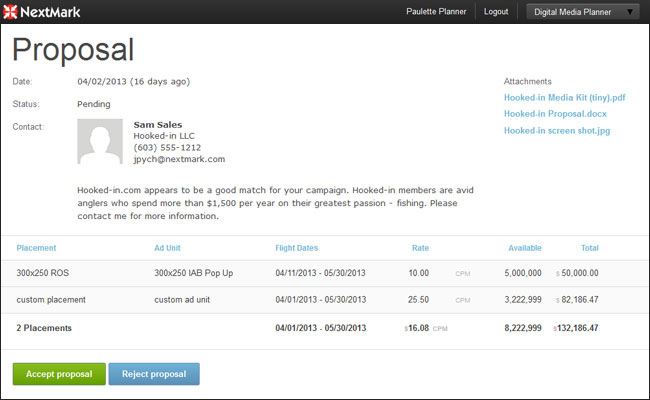
NextMark streamlines the RFP process with the latest upgrade to its Digital Media Planner system. Version 2.0 of Planner extends the platform’s functionality by enabling media planners to directly interact with publishers to request and manage media proposals. Now, instead of using spreadsheets and e-mail to negotiate pricing and placements, Planner’s Proposal Manager module enables you to:

  • Quickly and easily request proposals from any publisher
  • Automatically track the status of all RFP requests
  • Source additional proposals through Media Magnet
  • Receive proposals online with all documents automatically organized
  • Collaboratively review and negotiate proposals online
  • Accept proposals directly into your media plan with a button click

Unlike prior efforts to solve the RFP mess, NextMark has invested heavily into the design of the user experience for both buyers and sellers. Unlike other solutions, NextMark employs two modes of sourcing proposals: The typical RFP method and a new patent-pending Request for Consideration (or RFC) method. That latter enables qualified publishers to request consideration for plan-appropriate media, giving planners a wider array of choices when they construct their media plans.

“NextMark has been listening to its customers, and is building the right tools for digital media planning,” said Sean Cotton of True Media, an early Planner pilot user. “Adding RFP functionality to the planning tool really extends the functionality, and puts more of the workflow in a centralized place. Agencies have to start leveraging web-based tools to get smarter and more efficient about the way they plan and buy media—and get their planners to focus on more high value tasks that drive their clients’ success.”

Since its initial release only four months ago, Planner has already been upgraded four times based on new ideas from customers.

“This upgrade is another giant leap forward in delivering on the promise of programmatic direct buying,” remarked Joe Pych, NextMark’s President. “We’ve been getting fantastic advice from our development partner agencies, listening closely, and working diligently to realize this amazing vision. As a company, connecting media buyers and sellers is what we have been doing for 13 years, and I am glad we are starting to bring that same efficiency to digital.”

Planner 2.0 is available today. Free training is available to all registered users. To request more information or access to Planner, go to http://www.NextMark.com/planner.

How you Pay Your Agency Matters

April 16th, 2013

Paintbrush digging up a one hundred dollar bill

This post originally appeared in The CMO Site, a United Business Media publication.

I have been working for a company that makes software solutions for buying digital media, and I have worked for a number of ad technology companies in the past. In a world where digital banner ads are still purchased through e-mail and fax, and media plans are mostly created using Microsoft Excel—technology dating from 1985—the ad technology industry sees an opportunity to create efficiencies in the way media is bought and sold. As an industry, one of the odd dynamics we have encountered in bringing our product to market is how independent agencies are more apt to embrace new efficiencies than the “big four” owned agencies who lead the space in terms of media spend.

Logically, you would think that gigantic media agencies, managing hundreds of media planners and buying on thousands on digital media channels, would grasp at the chance to do more planning with fewer personnel, migrating towards web-based tools that offer efficiency and centralization. The evidence has shown otherwise. On the surface, it may seem as though the biggest difference between independent agencies and the majors is size. The majors have Ford, and the independents have the Ford dealers. They both work very hard to identify digital audiences, perform against marketers’ aggressive KPI goals, while trying to understand how they got there through detailed analytics. At the core, the difference between what media teams within holding company shops and a smaller agency does is minimal. So what accounts for the reluctance of bigger shops to innovate with technology tools?

One reason may be the way they get paid.

The biggest shops consistently rely upon cost-plus pricing, which pays them based on hours worked, plus an additional, negotiated margin. The typical $500,000 digital media plan takes an alarming 42 steps and nearly 500 man hours to complete, which can cost up to $50,000—and that doesn’t even include developing the creative. If you are paying your agency on a cost-plus basis, your agency doesn’t have a lot of incentive to create your plan faster, or with less labor. In fact, this type of pricing scheme creates an incentive for inefficiency, or what economists call a “perverse incentive.” Unfortunately, every cent you pay towards the labor of creating a media plan subtracts from the amount that can be dedicated to the media itself.

So, what to do? The most obvious choice for those working with a large agency under such a scheme is to try and change the payment terms. Pay-for-performance is optimal, but a careful analysis may show that paying on a percentage-of-spend model yields more reach, when you are not paying for the labor of building a media plan. Some marketers are choosing instead to build small, efficient in-house teams to leverage the demand side technologies that their agency won’t to discover and buy digital media. Other marketers choose to work with multiple smaller, independent agencies that have specific expertise in different digital verticals. Those shops usually offer flexible fee structures, and you are far more likely to work with the team that pitched you after you hire them.

As they say in finance, “it isn’t what you make, it’s what you keep.” In digital media, moving away from cost-plus pricing relationships and towards new technologies for media buying means keeping more of your money for reach, and spending less on labor that doesn’t help you move the sales needle.


NextMark nominated for ASPY award for “Best New Technology”

April 15th, 2013

nextmark aspy award nomination

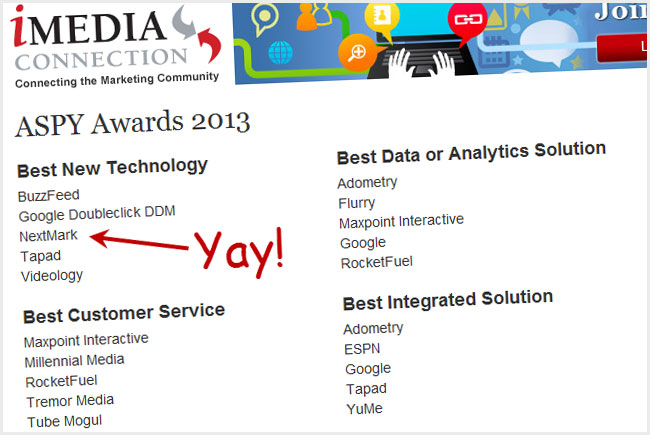
I’m extremely happy to announce that NextMark has just been nominated for an ASPY award in the category of “Best New Technology” for our new Digital Media Planner tool. This award is given to “The company that has created the most impactful new technology platform specific to media, ad operations, social media, or mobile marketing. Nominees must include products specific to the advancement of media and advertising.”

It’s a tremendous honor to get this nomination because it comes from people who really know the business: highly respected industry veterans in the iMedia community who’ve seen just about everything and are experts in running digital advertising agencies. For them to select NextMark out of the hundreds of new technologies recently developed is a huge validation of the products we’ve been building to streamline digital media planning workflow. It’s also a huge validation of the fantastic advice we’ve been getting from our development partner agencies!

The winner will be announced on May 7th at the iMedia Agency Summit in Austin, Texas.